Introduction: A New Milestone in India’s Border Infrastructure
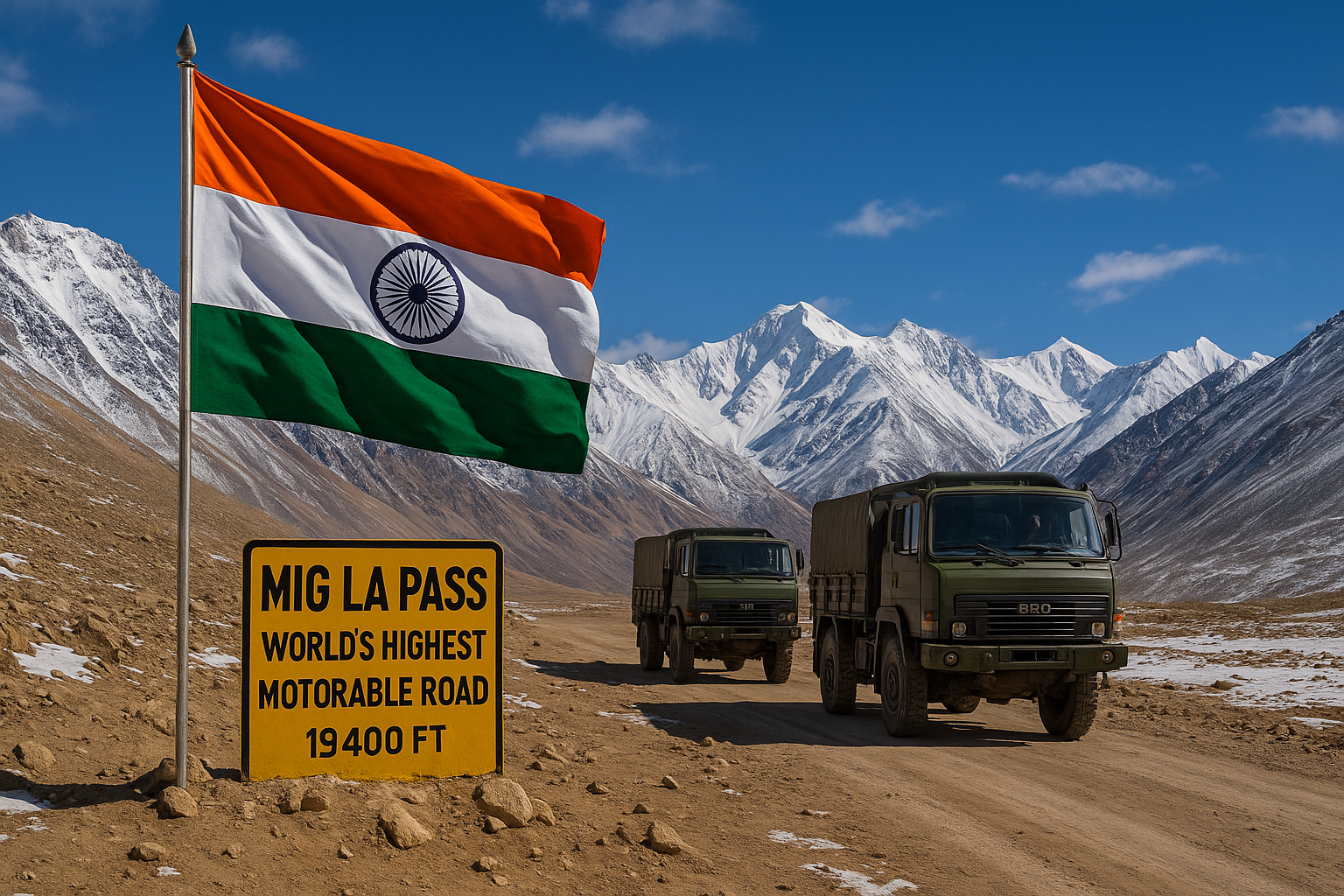
In October 2025, India once again etched its name in the Guinness World Records — this time for creating the world’s highest motorable road at an astounding altitude of 19,400 feet (5,913 metres). Built by the Border Roads Organisation (BRO) under Project Himank, the newly completed Likaru–Mig La–Fukche Road has surpassed the previous record set by Umling La Pass (19,024 ft).
This achievement is not just an engineering triumph; it’s a testament to India’s strategic foresight, technological capability, and commitment to improving connectivity in one of the most remote and challenging regions of the world — Eastern Ladakh.
The Road That Touches the Sky: Location and Strategic Importance
The record-setting road connects Hanle to Fukche, two remote settlements near the Line of Actual Control (LAC). The route passes through the Mig La Pass, a high-altitude corridor that links the cold desert plateau with crucial border areas where India maintains forward deployment.
This project enhances accessibility in areas that often remain cut off for months during harsh winters. For the local population, it means better access to medical facilities, education, and supplies. For the armed forces, it means quicker deployment, improved logistics, and a stronger presence along the LAC — a region of growing geopolitical sensitivity.
A Guinness World Record for the BRO
The BRO, known for constructing some of the most difficult mountain roads on the planet, now holds the Guinness World Record for the third time.
- Khardung La (18,380 ft) held the title for several decades.
- In 2020–2021, the BRO broke its own record with Umling La Pass (19,024 ft).
- Now, in 2025, Mig La (19,400 ft) takes the crown.
The continuous breaking of altitude barriers highlights India’s evolving capability in high-altitude engineering and border infrastructure. It also underscores the organisation’s motto: “Shramena Sarvam Sadhyam” — “Everything is Achievable Through Hard Work.”
Building at 19,400 Feet: Challenges Beyond Imagination
Constructing a road at nearly 6,000 metres above sea level is a battle against nature itself. The conditions at such altitudes are harsh, with oxygen levels nearly 50% lower than at sea level.
The construction teams faced:
- Extreme cold, with temperatures often dipping below -25°C.
- Rocky and unstable terrain, where machinery often malfunctioned due to freezing fuel and low air pressure.
- Short working windows, limited to a few daylight hours in summer when the weather was stable.
Despite these hurdles, the BRO’s team — led by Brigadier Vishal Srivastava — persisted. They carefully planned operations during limited weather windows, transported heavy machinery through rough terrain, and ensured crew safety at every step.
When the project was finally completed, the Indian flag was raised atop Mig La, marking a proud moment in the history of Indian infrastructure.
Technology and Precision: The Backbone of Project Himank
Project Himank has been responsible for building some of the most iconic roads in Ladakh, including those leading to Pangong Tso, Tso Moriri, Umling La, and now Mig La.
To build at such an altitude, BRO engineers relied on:
- Special high-altitude construction equipment, designed to operate in low-oxygen conditions.
- Modified fuel and lubricants, preventing engine freeze in sub-zero temperatures.
- Geo-synthetic materials, to strengthen road surfaces against frost heave and permafrost damage.
Every meter of this road required detailed geotechnical analysis and terrain stabilization. This technological excellence makes Mig La not just the highest but also one of the most resilient motorable roads in the world.
Boosting Connectivity and Local Economy
The Likaru–Mig La–Fukche route offers multiple benefits beyond military use.
It will:
- Enhance accessibility for local residents of Hanle and Fukche.
- Reduce travel time between remote villages and Leh.
- Support tourism in regions like Hanle, known for the Indian Astronomical Observatory.
- Improve supply chains, allowing essential goods to reach remote communities faster.
The road also holds immense potential for eco-tourism and adventure travel. In the coming years, the route could attract off-road enthusiasts, photographers, and travelers eager to experience the “roof of the world” — responsibly and sustainably.
India’s Strategic Advantage Along the LAC
From a national security standpoint, the new road strengthens India’s ability to rapidly mobilize troops and equipment along the LAC.
The Likaru–Mig La–Fukche corridor provides alternate connectivity between critical forward areas, improving operational readiness. With the ongoing focus on border infrastructure in Ladakh and Arunachal Pradesh, India continues to reinforce its position in high-altitude regions that are both strategically and symbolically significant.
Environmental and Human Factors
The BRO has emphasized eco-friendly practices while constructing in these fragile ecosystems.
Efforts include:
- Controlled blasting to minimize terrain damage.
- Use of biodegradable lubricants.
- Scheduled replantation drives along road corridors.
Additionally, BRO teams provided medical camps, oxygen support systems, and proper acclimatization periods to protect workers’ health during construction. These safety-first protocols ensured that no major human casualty occurred despite the extreme working conditions.
Voices from the Ground: Pride and Perseverance
Brigadier Vishal Srivastava, who led the project, credited the success to his team’s spirit and discipline:
“At 19,400 feet, even breathing becomes a challenge. Yet, our engineers and workers stood firm. This achievement belongs to every BRO soldier who believes no mountain is too high for India.”
Local residents, too, expressed hope that the new road will bring development and year-round connectivity to regions that were once cut off for months due to snow.
India’s Legacy of Record-Breaking Roads
India’s Himalayan frontier has long been a symbol of national pride and resilience.
Some of the country’s highest and most scenic motorable passes include:
- Mig La (19,400 ft) – World’s highest (2025)
- Umling La (19,024 ft) – Former record holder
- Khardung La (18,380 ft) – Once the gateway to Siachen
- Chang La (17,586 ft) – Route to Pangong Lake
- Tanglang La (17,582 ft) – On the Leh–Manali Highway
Together, these roads form the lifelines of Ladakh — both strategically and culturally.
Conclusion: A Triumph of Grit, Glory, and Geography
The completion of the Likaru–Mig La–Fukche Road stands as a shining symbol of India’s perseverance. It demonstrates that even the world’s harshest environments can be tamed with determination and innovation.
More than a record, it is a message of resilience — to connect, protect, and empower those who live in the shadows of the Himalayas.
As the tricolour flutters at 19,400 feet, India once again proves that when challenges rise, so does its spirit.