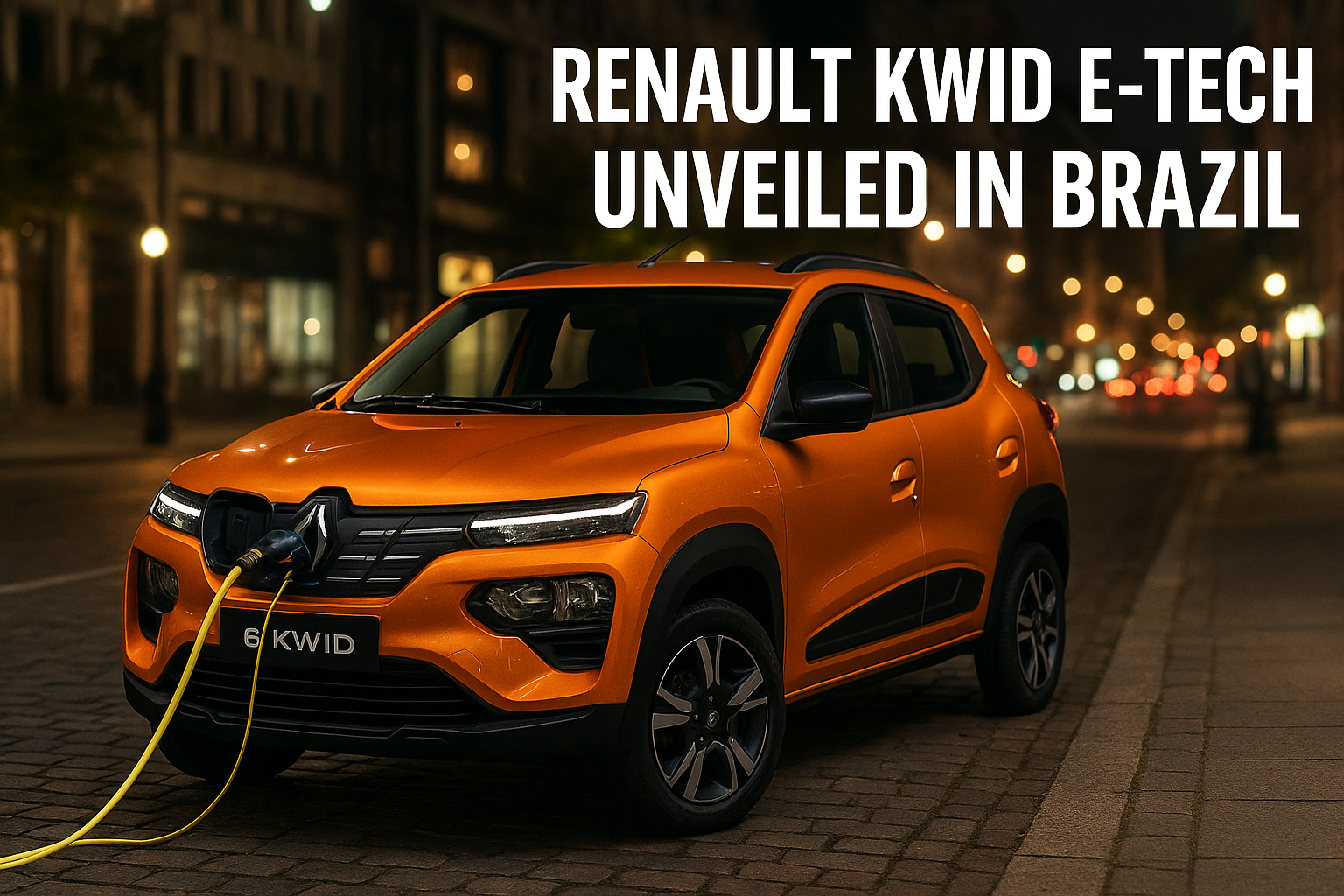
In a bold step toward mass-market electrification, Renault has unveiled the all-electric version of the Kwid hatchback in Brazil, officially named the Renault Kwid E-Tech. Designed to offer accessible electric mobility for urban users, the compact hatch combines affordability, efficiency, and practicality in one futuristic package.
The unveiling comes as part of Renault’s global push to expand its electric lineup beyond Europe, targeting emerging markets like Brazil and India, where compact city EVs are gaining traction.
Design Overview: Familiar Shape, Futuristic Detailing
The Renault Kwid E-Tech retains the compact proportions of the standard Kwid but carries a sharper, more modern design language that emphasizes its electric identity.
Front Profile
The front fascia is completely reworked for aerodynamic efficiency. The traditional grille has been replaced with a closed-off panel featuring the Renault logo and a front-mounted charging port — a signature cue of modern EVs.
Distinctive rocket-shaped LED DRLs sit above projector headlights, while the lower bumper is contoured to enhance air flow.
Side Profile
The sides feature contrasting black wheel arch claddings, dual-tone 14-inch alloy wheels, and indicator-integrated ORVMs. The black side cladding runs the length of the car, giving it a sportier stance.
While the design feels contemporary, the traditional pull-type door handles seem dated for 2025 standards — likely retained to maintain cost efficiency.
Rear Design
At the rear, the EV badging takes center stage with ‘E-Tech’ and ‘E Kwid’ monograms. The tail-lamps have a revised light signature, and the bumper features a gloss-black insert for contrast.
Interior and Cabin Features
Inside, Renault has created a modern and tech-friendly cabin that aligns with the expectations of urban EV buyers.
The dashboard layout feels familiar but adds futuristic touches with metallic and tri-wing accents inspired by rockets — a design theme seen around the AC vents and door trims.
Infotainment and Display
- 10.1-inch touchscreen infotainment system
- Wireless Android Auto and Apple CarPlay support
- 7-inch fully digital instrument cluster
- Bluetooth, USB-C ports, and steering-mounted controls
The interface has been reworked for EV-specific information such as energy flow, range, and regenerative braking indicators.
Comfort and Practicality
The Kwid E-Tech features:
- Height-adjustable steering wheel
- Console-mounted e-shifter
- Dual USB-C charging ports
- 290-litre boot space
- Auto climate control
Despite its compact size, Renault has ensured adequate headroom and legroom for four adults — making it one of the most practical city EVs in its segment.
Powertrain and Performance
Under the hood, or rather under the floor, lies a 26.8 kWh lithium-ion battery pack powering a 48 kW (65 hp) electric motor that delivers 11 Nm of torque.
While the torque figure may seem modest, instant throttle response ensures brisk acceleration in city traffic. Renault claims:
- 0–50 km/h in 4.1 seconds
- 0–100 km/h in 14.6 seconds
This makes the Kwid E-Tech quick off the line — ideal for dense urban environments where short bursts of speed matter more than outright performance.
Range and Charging Details
Renault has engineered the Kwid E-Tech for flexibility in charging options, supporting both AC and DC systems.
- DC Fast Charging (30 kW): 15% to 80% in 40 minutes
- AC Wallbox (7.4 kW): 15% to 80% in 2 hours 54 minutes
The battery management system optimizes temperature control, extending battery life in Brazil’s warm climate. Though Renault hasn’t revealed the certified driving range yet, it’s expected to deliver around 230–250 km on a full charge (WLTP equivalent) — suitable for daily city commutes.
Safety and ADAS Features
Renault has equipped the Kwid E-Tech with a robust set of safety features, elevating it above the typical small EV segment.
Key safety features include:
- Six airbags
- ABS with EBD
- Electronic Stability Program (ESP)
- Hill Start Assist
- Rearview camera with guidelines
- ISOFIX child seat mounts
- Tyre Pressure Monitoring System (TPMS)
- Speed limiter & seatbelt warning
Additionally, the Kwid E-Tech introduces a Level 1 ADAS (Advanced Driver Assistance System) suite with 11 assistive features such as:
- Forward Collision Alert
- Auto Emergency Braking
- Lane Departure Warning
- Driver Attention Monitoring
These advanced features make the E-Tech one of the most safety-focused entry-level EVs in its class.
Pricing and Market Positioning
In Brazil, the Renault Kwid E-Tech has been priced at BRL 99,990, which translates to roughly ₹16 lakh in Indian currency. This makes it one of the most affordable electric cars available in the Brazilian market, competing against models like the BYD Dolphin Mini and JAC E-JS1.
While its India launch hasn’t been confirmed yet, industry insiders expect Renault to introduce a cost-optimized version locally — possibly with a smaller battery and simplified ADAS setup — to keep prices competitive around the ₹10–12 lakh range.
India Launch Possibility: What to Expect
Given Renault’s strong presence in India and its growing focus on sustainable mobility, an Indian version of the Kwid E-Tech seems highly likely.
If launched, it would go up against:
- Tata Tiago EV
- Citroën ëC3
- MG Comet EV
For India, the car might use local battery sourcing, revised range calibration, and possibly different charging connectors (GB/T) to align with local infrastructure.
Global Context: Renault’s Expanding EV Footprint
The Renault Kwid E-Tech is a part of the brand’s global E-Tech strategy, which focuses on democratizing EV ownership. After success with larger models like the Megane E-Tech and Scenic E-Tech, the Kwid brings this technology to an entry-level segment, targeting first-time EV buyers.
Renault aims to position the Kwid E-Tech as an urban mobility solution that combines affordability with low running costs — a key factor for both developing and mature markets.
Expert Insight: Why the Kwid E-Tech Matters
The Kwid EV’s biggest strength lies in its balance of simplicity and technology. It’s not trying to compete with premium EVs but instead aims to bridge the gap between two-wheelers, entry-level ICE cars, and fully electric mobility.
In countries like Brazil and India — where compact cars dominate sales — the Kwid E-Tech could potentially serve as the gateway vehicle for EV adoption, accelerating the shift toward sustainable transportation.
Conclusion: The Affordable EV Revolution Begins
The unveiling of the Renault Kwid E-Tech in Brazil represents more than just a product launch — it’s a sign that affordable electric cars are finally becoming a global reality.
With its compact design, strong safety package, quick charging capabilities, and user-friendly features, the Kwid E-Tech is built to appeal to the masses rather than the elite.
As Renault continues to evolve its E-Tech lineup, the Kwid EV could very well become one of the most influential small EVs in the world — proving that sustainability doesn’t have to come at a premium.