Meta title: BYD Sealion 7 vs Hyundai Ioniq 5 vs BMW iX1 LWB – Real-world Comparison (2025)
Meta description: Planning a premium EV around ₹50 lakh? We compare BYD Sealion 7, Hyundai Ioniq 5 and BMW iX1 LWB on design, space, features, performance, charging and range to help you choose the right one.
The brief
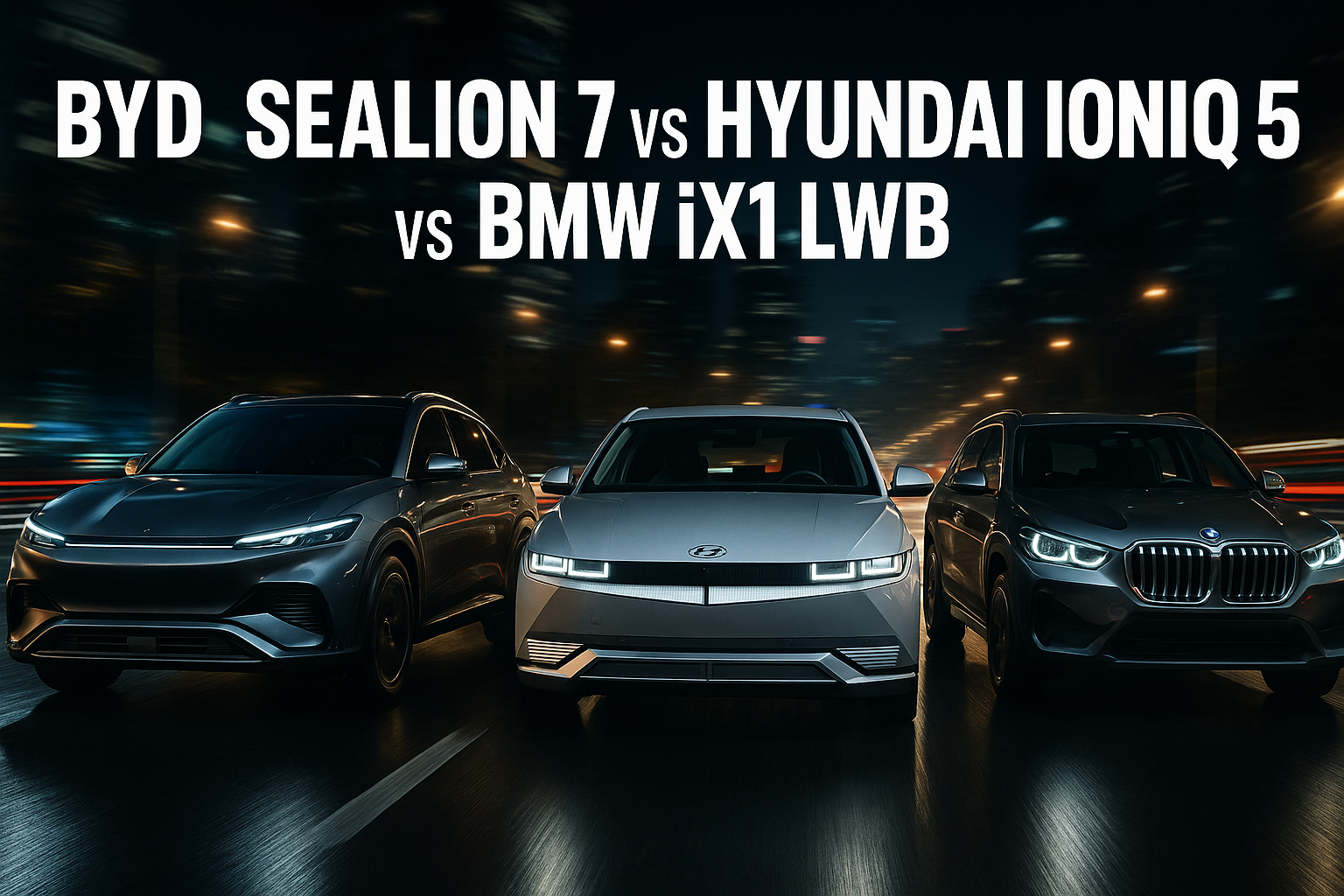
If your budget sits close to ₹50 lakh and you want a premium electric crossover, the three names that naturally pop up are BYD Sealion 7, Hyundai Ioniq 5 and BMW iX1 LWB. They overlap on price but differ in size, hardware and character: the BYD is the largest and most powerful (especially in Performance AWD guise), the Ioniq 5 majors on comfort and charging speed, and the iX1 LWB leans on brand polish and a long rear cabin. Here’s a clean, ad-safe, human-written breakdown that sticks to facts you can use.
| Measure | BYD Sealion 7 (Performance) | BMW iX1 LWB eDrive20L | Hyundai Ioniq 5 |
| Length | 4,830 mm | 4,616 mm | 4,635 mm |
| Width | 1,985 mm | 1,845 mm | 1,890 mm |
| Height | 1,620 mm | 1,627 mm | 1,625 mm |
| Wheelbase | 2,930 mm | 2,800 mm | 3,000 mm |
| Boot (rear) | 500 L (plus 58 L frunk) | ~490 L | 527 L (plus 57 L frunk) |
| Tyres | 245/45 R20 | 225/55 R18 | 255/45 R20 |
Takeaways
- Ioniq 5 has the longest wheelbase and the largest boot, which translates to a lounge-like cabin and excellent luggage usability.
- Sealion 7 is the longest and widest; it feels like a size up inside, especially in shoulder room.
- iX1 LWB is the most compact outside but carves out generous rear legroom thanks to its stretched wheelbase.
2) Cabin feel & usability
BYD Sealion 7
Rounded, modern design with a large 15.6-inch rotating touchscreen. Fit and finish are tidy and feature count is rich (tinted rear glass, big panoramic roof, extensive driver assistance). Front seats get ventilation; the rear bench is supportive and the cabin feels plush. Some owners may find the driver’s display busy and the ride slightly firm on 20-inch wheels.
BMW iX1 LWB
Familiar BMW layout with a curved twin-screen, a floating console and excellent material consistency on touchpoints. The rear seat benefits most from the LWB—more recline and leg support than the standard wheelbase. Front seats are supportive but narrow for larger frames and lack ventilation. Interface depth can feel complex at first use.
Hyundai Ioniq 5
Minimalist “neo-retro” lounge: flat floor, movable centre console, many clever storage zones (including a big drawer-style glove box). Broad, plush front seats with ventilation/heating and ottoman-style leg rest; panoramic fixed glass roof accentuates the sense of space. Rear bench is wide enough for three, with heating on the outer seats. White upholstery looks premium but needs care.
Verdict (cabin):
Comfort and ease of use = Ioniq 5. Rear legroom and brand polish = iX1 LWB. Tech-rich luxury vibe with airy space = Sealion 7.
3) Powertrain, performance & refinement
| Item | Sealion 7 Performance (AWD) | iX1 eDrive20L (FWD) | Ioniq 5 (RWD) |
| Battery | 82.56 kWh (LFP) | 66.4 kWh (NMC) | 72.6 kWh (NMC) |
| Power | 530 hp | 204 hp | 217 hp |
| Torque | 690 Nm | 250 Nm | 350 Nm |
| Drive | AWD | FWD | RWD |
| 0–100 km/h | ~4.4 s | ~8.3 s | ~7.5 s |
On the road
- Sealion 7 is the outright sprinter. The dual-motor AWD puts power down cleanly and the surge is serious. At speed you’ll hear more wind/road noise than in the Hyundai; the 20-inch wheels add some edge over sharp bumps.
- iX1 LWB is calm and composed rather than quick. FWD layout can show a hint of torque steer if you mash the throttle. Chassis tuning and ride absorption are excellent for daily use.
- Ioniq 5 blends smooth, linear shove with very good isolation. It doesn’t chase lap times; instead it feels natural and relaxed, which is what most buyers want.
Verdict (performance): Speed thrills = Sealion 7. Quiet, natural daily drive = Ioniq 5. Balanced, tidy manners with premium feel = iX1 LWB.
4) Efficiency, real-world range & charging
| Metric | Sealion 7 Perf. | iX1 LWB | Ioniq 5 |
| City efficiency (km/kWh) | 4.90 | 6.48 | 7.07 |
| Highway efficiency (km/kWh) | 4.17 | 5.60 | 5.67 |
| Tested range (combined) | ~371 km | ~398 km | ~457 km |
| DC fast-charge peak | up to ~150 kW | up to ~130 kW | up to ~350 kW |
| V2L / V2V | Yes / Yes | – | Yes / Yes |
What matters
- If you do inter-city trips, Ioniq 5 is the easiest to live with: best real-world range plus class-leading fast-charge capability.
- Sealion 7 has the biggest battery, but its Performance AWD tune focuses on power; the RWD variant typically improves range if that’s your priority.
- iX1 LWB sits in the middle for efficiency and charge speed—good for urban owners who primarily AC charge at home and want a premium badge.
5) Features & safety (highlights)
Common ground: panoramic glass roof, connected tech, wireless charging, driver-assist suite (ADAS), multiple airbags (6+), 360° camera, drive/regen modes.
Where they differ
- Sealion 7: 11 airbags, Dynaudio audio, wireless phone projection, tinted rear glass, generous ADAS set.
- iX1 LWB: Premium ambience, Harman Kardon audio (variant dependent), smartphone-enabled key; feature list is shorter than the other two but cabin quality stays high.
- Ioniq 5: Ventilated and heated front seats, heated outer rear seats, sliding console, easy UI, Bose audio, 360° camera, V2L, superb storage solutions.
Safety note: All three offer robust active safety suites; always check the specific variant equipment before booking.
6) Ride & handling character
- Sealion 7: Confident straight-line stability; some body roll in fast bends due to mass and a quick steering ratio. The 20-inch wheels look great but transmit sharp edges.
- iX1 LWB: Feels the most “European” dynamically—planted, tidy and absorbent. The long wheelbase dials back the agility of the dual-motor short-wheelbase iX1, but overall balance is excellent for Indian roads.
- Ioniq 5: Maturity is the theme—silky ride, well-damped movements, and direct steering. Not sporty, but very comfortable on mixed surfaces.
7) Price view (ex-showroom)
- BMW iX1 LWB eDrive20L: ~₹49 lakh
- Hyundai Ioniq 5 (RWD): ~₹46.05 lakh
- BYD Sealion 7: ~₹54.90 lakh (Performance AWD); RWD variant typically priced lower with higher claimed range
On-road prices vary by city and insurance/registration.
8) Which one should you buy?
Pick the BYD Sealion 7 if…
- You want maximum power and AWD traction.
- A rich feature set with big-screen flair appeals to you.
- You’re okay trading some ride plushness and ultimate efficiency for performance and presence.
Pick the BMW iX1 LWB if…
- You value brand polish, high-quality cabin touchpoints and an absorbent ride.
- You’ll be chauffeur-driven often—the long rear cabin and recline help.
- You primarily drive in the city and prefer a calm, easy EV experience.
Pick the Hyundai Ioniq 5 if… (our all-rounder choice)
- You want the best real-world range and fastest DC charging in this trio.
- Comfort, space and simple, intuitive UX matter more than outright speed.
- You like future-proof touches such as V2L to power appliances or charge another device/EV.
Bottom line:
- Performance king: BYD Sealion 7 Performance (AWD).
- Premium daily driver: BMW iX1 LWB.
- Best overall package for most buyers: Hyundai Ioniq 5 thanks to range, charging speed, comfort and value.
Quick spec recap
- Sealion 7 Performance: 82.56 kWh LFP, 530 hp/690 Nm, AWD, 0–100 in ~4.4 s, tested range ~371 km.
- iX1 LWB eDrive20L: 66.4 kWh NMC, 204 hp/250 Nm, FWD, 0–100 in ~8.3 s, tested range ~398 km.
- Ioniq 5 (RWD): 72.6 kWh NMC, 217 hp/350 Nm, RWD, 0–100 in ~7.5 s, tested range ~457 km, DC fast up to 350 kW.
FAQs (for Featured Snippets)
Q1. Which premium EV has the best real-world range under ₹50–55 lakh?
A. Hyundai Ioniq 5—in mixed use it typically returns the longest usable range and also supports ultra-fast DC charging.
Q2. Which one is the quickest to 100 km/h?
A. BYD Sealion 7 Performance with dual-motor AWD (around 4.4 seconds).
Q3. Which EV is most comfortable for a family of five?
A. Ioniq 5 for its wide rear bench and lounge-like cabin; iX1 LWB if you want a reclined rear seat feel with a premium badge.
Q4. Is AWD necessary?
Not for city use. AWD (Sealion 7 Performance) helps with traction and straight-line performance; RWD/FWD are lighter and often more efficient.