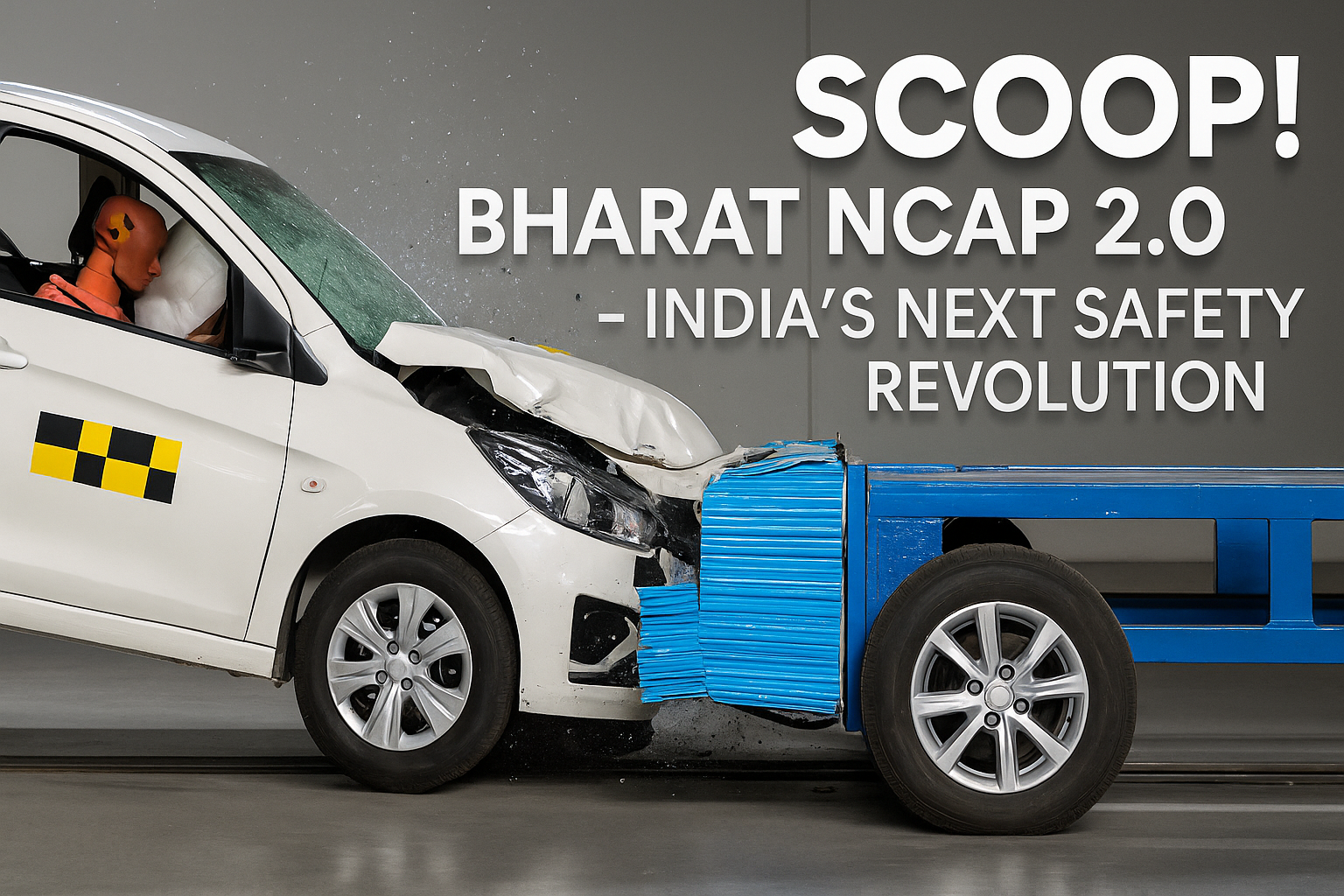
ndia’s vehicle safety standards are about to enter a transformative phase. The Bharat New Car Assessment Programme (Bharat NCAP) — introduced in 2023 to bring Indian testing in line with global norms — is set for a major evolution. The upcoming Bharat NCAP 2.0, expected around late 2027, will introduce new crash-testing parameters, including full frontal and rear impact tests, and will employ next-generation crash dummies for more accurate injury data.
This marks an important leap for India’s automotive safety ecosystem — one that not only protects drivers and passengers but also builds consumer trust in made-in-India vehicles.
The Road So Far: Bharat NCAP’s Impact Since 2023
Launched in October 2023, Bharat NCAP has been India’s first-ever independent car safety rating programme.
Under its first phase, cars are voluntarily tested across key parameters such as:
- Frontal Offset Deformable Barrier (FODB) crash test at 64 km/h
- Side impact test simulating a T-bone collision
- Side pole impact test for structural and occupant safety
- Child restraint system (CRS) compatibility
- Safety assist technologies like ESC, seatbelt reminders, and ISOFIX
Each car is awarded a star rating out of five for adult occupant protection (AOP) and child occupant protection (COP).
Within just two years, 24 vehicles have already been tested under this voluntary scheme — helping car buyers make more informed choices based on safety, not just price or features.
What Changes in Bharat NCAP 2.0?
The next phase — Bharat NCAP 2.0 — aims to elevate India’s car-testing framework to match international programs like Euro NCAP and Global NCAP. According to officials involved, the upcoming version will bring three major upgrades:
1. Full Frontal Impact Test
Currently, India follows a partial-overlap frontal crash test, where only 40% of the vehicle’s width (driver side) impacts the barrier.
In the new system, cars will undergo a full frontal crash test, where 100% of the vehicle’s width collides with a rigid barrier at high speed.
This provides deeper insight into seatbelt strength, airbag deployment timing, and dashboard safety.
2. Rear Impact Crash Test
Bharat NCAP 2.0 will introduce rear-impact testing, addressing passenger whiplash injuries, fuel-tank integrity, and boot-space safety.
Until now, rear crash-worthiness has largely been untested in India. This test is crucial because rear-end collisions account for nearly 15% of total road crashes in urban India.
3. Advanced Crash Dummies
More technically advanced dummies will be used, especially for side pole impacts.
These next-generation dummies replicate human body responses more precisely, capturing data on potential neck, chest, and leg injuries.
This will help engineers design better crumple zones, airbags, and seat geometries.
Testing ADAS and Safety Technologies
One of the most forward-looking aspects of Bharat NCAP 2.0 will be its inclusion of Advanced Driver Assistance Systems (ADAS) in testing protocols.
These include:
- Autonomous Emergency Braking (AEB)
- Lane-Keep Assist (LKA)
- Blind-Spot Monitoring (BSM)
- Adaptive Cruise Control (ACC)
As these technologies become standard in mid-segment cars, India’s test standards must ensure that ADAS works reliably under local conditions — from monsoon downpours to crowded city traffic.
Officials have already indicated that the new system will test whether these safety systems actually remain active during critical moments, rather than being disabled by drivers or dealers.
Why Bharat NCAP 2.0 Matters for India
India records over 1.5 lakh road fatalities each year — one of the highest in the world.
While infrastructure and driver behavior play roles, vehicle safety standards directly influence survival rates in accidents.
Bharat NCAP 2.0 is expected to:
- Encourage manufacturers to design safer cars proactively.
- Give buyers transparent data on crash safety.
- Help India align with UN vehicle safety regulations (UN R-series).
- Build a safety-first culture among consumers and automakers.
In essence, the programme will move the Indian car market from “cheap and efficient” to “safe and reliable.”
Implementation Timeline and Expected Rollout
According to internal sources, the implementation of Bharat NCAP 2.0 is targeted for late 2027.
Before rollout, test labs, crash tracks, and digital data systems across India — including those managed by ARAI (Pune), GARC (Chennai), and ICAT (Manesar) — will undergo major upgrades.
These centers are being equipped with high-speed cameras, biofidelic sensors, and simulation software for advanced testing.
Between 2025 and 2027, authorities will conduct pilot tests on select models to validate new methodologies before full adoption.
Car Manufacturers’ Perspective
Automakers in India are responding positively to the Bharat NCAP initiative.
While the tests are voluntary, brands that score high star ratings use it as a marketing advantage.
Companies such as Tata, Mahindra, and Maruti Suzuki have already committed to designing vehicles for future Bharat NCAP compliance, viewing it as an investment in brand trust.
With Bharat NCAP 2.0, manufacturers will need to upgrade rear structures, airbag calibration, and sensor integration — especially for ADAS systems.
It may increase development costs initially, but in the long term, it’s expected to improve export readiness and global competitiveness.
How It Benefits Indian Consumers
For the average Indian car buyer, Bharat NCAP 2.0 means:
- Better protection for both front and rear occupants
- Improved child safety mechanisms
- Transparent star ratings that reflect real-world performance
- Access to technologically safer cars even in budget segments
With rising road awareness and stricter government oversight, safety is now emerging as a key decision factor alongside mileage and price.
India’s Journey to Global Safety Standards
India’s effort to standardize crash-testing aligns with its Vision Zero Accident Mission, which aims to minimize fatalities by 2030.
The move to full-frontal and rear crash testing puts Bharat NCAP in the same league as Euro NCAP, ANCAP (Australia), and Latin NCAP.
What sets Bharat NCAP apart, however, is its India-specific calibration — factoring in road conditions, driver behavior, and traffic density unique to the country.
By 2027, Bharat NCAP 2.0 could become a benchmark for emerging economies, proving that affordable cars can also be world-class in safety.
Consumer Awareness: The Final Piece of the Puzzle
While upgraded testing standards are essential, consumer education is equally critical.
Buyers need to understand that:
- A 5-star safety rating can make the difference between life and death in a crash.
- Rear seatbelts, child seats, and proper airbag use are non-negotiable.
Campaigns are already being planned to raise awareness about reading and interpreting Bharat NCAP ratings before purchasing a car.
Conclusion: Driving Towards a Safer Future
The upcoming Bharat NCAP 2.0 is more than just a regulatory update — it’s a national commitment to safety, innovation, and accountability.
By integrating full-frontal and rear crash tests, advanced dummies, and ADAS evaluation, India is taking a decisive step toward global safety parity.
For carmakers, it’s a call to innovate responsibly.
For consumers, it’s reassurance that safety no longer depends on price.
And for India, it’s another milestone on the road to becoming a global automotive hub built on trust, not compromise.