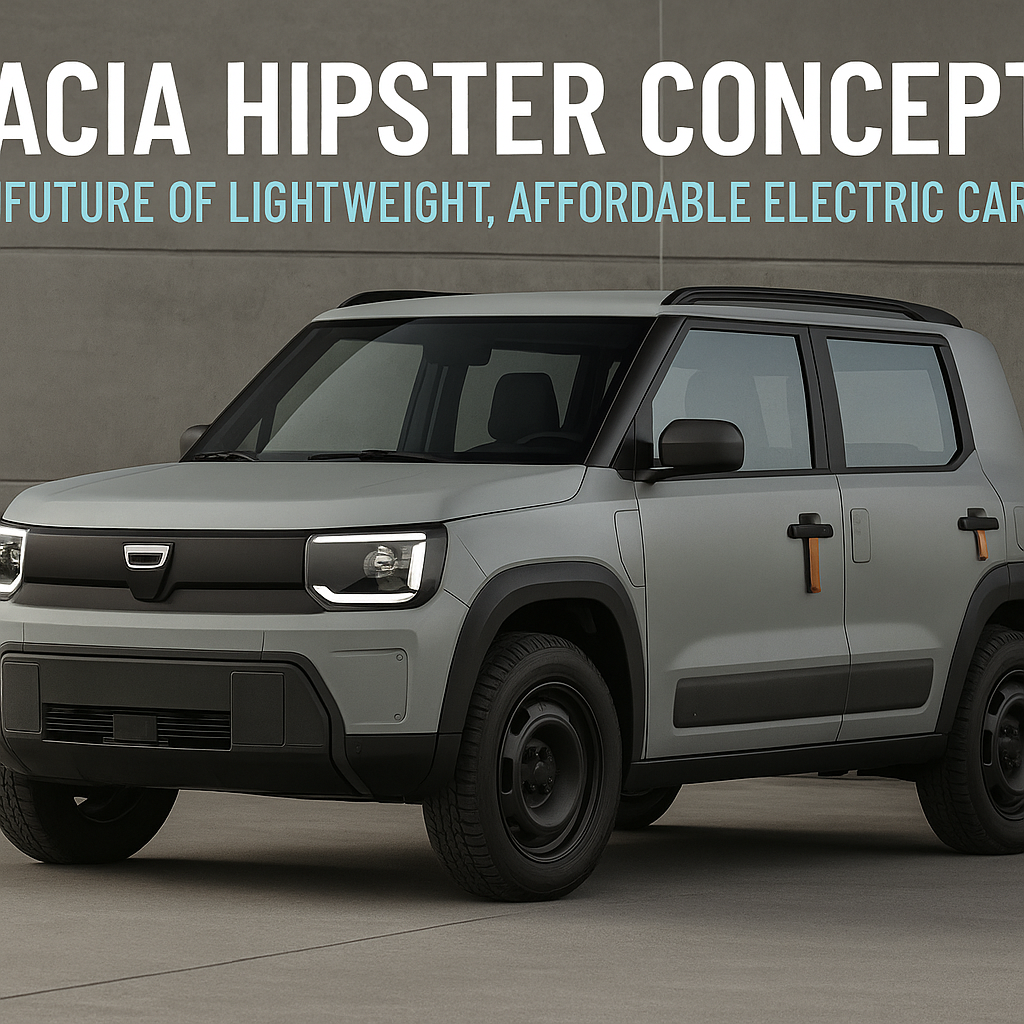
In an era where electric vehicles are becoming larger, heavier, and more expensive, Dacia has chosen a radically different path. The automaker has unveiled the Dacia Hipster Concept, a prototype that embodies simplicity, efficiency, and affordability — a reminder that electric mobility doesn’t need to be complex or costly.
Weighing under 800 kg and measuring just 3.0 metres in length, the Dacia Hipster is a statement of minimalism. It challenges the industry trend of feature-laden EVs by focusing solely on what drivers genuinely need — four seats, a small battery, and a lightweight, repair-friendly design.
This concept is more than just an experimental showcase; it’s a strategic vision for accessible electric driving in Europe and emerging markets alike.
Dacia’s Vision – Simplicity as a Strength
Dacia has long been associated with practicality and value. Models like the Sandero and Duster earned their popularity by delivering no-nonsense engineering at accessible prices.
With the Hipster Concept, Dacia extends this philosophy into the electric era. The focus is clear: build a car that’s light, functional, repairable, and inexpensive, rather than competing in the race for digital gimmicks and excessive range.
In an official statement accompanying the reveal, Dacia’s design team highlighted that the Hipster is about rethinking the essentials of mobility — creating an EV that does not rely on heavy batteries or expensive electronics but still provides the freedom and utility of a modern city car.
Ultra-Lightweight Design – Less Is More
At under 800 kilograms, the Hipster weighs less than half of many compact EVs on the market today.
This low weight brings several advantages:
- Reduced energy consumption
- Smaller, cheaper battery packs
- Faster charging times
- Lower manufacturing footprint
By keeping the mass down, Dacia can use a modest battery without compromising on range. The automaker describes its approach as “sizing as needed”, where both the motor and battery are optimized for everyday city use — no excess, no waste.
This design not only lowers production costs but also significantly reduces the car’s total lifecycle emissions, a key environmental metric in the electric era.
Built for the City, Designed for Real Life
Measuring just 3.0 metres long, the Dacia Hipster is shorter than a typical hatchback yet tall and boxy enough to seat four adults comfortably.
The design incorporates:
- Tall glass windows for visibility
- Short overhangs for better maneuverability
- Upright body styling for maximum space efficiency
This makes it an ideal choice for urban environments, where agility, parking ease, and compact dimensions matter more than high-speed performance.
Inside, there’s a fold-down boot for flexible cargo storage — a simple, effective solution for grocery runs or weekend luggage.
Minimalist Interior – Function Over Frills
The cabin of the Dacia Hipster is a refreshing throwback to simplicity. Every element has a purpose, and nothing is over-engineered.
Key features include:
- Lightweight seats with exposed frames and mesh fabric
- Sliding manual windows instead of costly electric mechanisms
- Fabric pull straps instead of traditional door handles
- Smartphone dock replacing a built-in infotainment screen
Your phone becomes the central control hub — handling navigation, music, and even the digital key.
This minimalist approach serves two purposes:
- Cost reduction – by removing expensive electronics
- Repair simplicity – fewer parts mean easier maintenance
Dacia says that this approach allows owners to customize and upgrade tech independently, ensuring the car remains relevant over time without requiring expensive software updates.
Exterior Design – Rugged, Honest, and Recyclable
The Hipster Concept wears its ruggedness proudly. The car’s exterior is designed for durability and ease of repair.
- Many body panels are left unpainted, reducing chemical usage and simplifying repairs.
- Fabric straps replace conventional handles, echoing outdoor and adventure gear design cues.
- The overall shape is boxy but practical, maximizing interior volume within a small footprint.
This design language aligns with Dacia’s recent aesthetic evolution — rugged yet minimal, emphasizing function over form.
Even the materials used reflect environmental responsibility: recycled plastics, simple fasteners, and modular body components that can be replaced individually if damaged.
Powertrain Philosophy – Efficiency Over Excess
Unlike many EV makers chasing ever-higher range and power figures, Dacia believes in real-world efficiency.
While official specifications haven’t been disclosed, insiders suggest the Hipster will feature a compact electric motor and a small-capacity battery, providing sufficient range for daily urban driving.
The brand’s engineers state that by halving the vehicle’s weight, they can also halve the energy requirements — allowing the Hipster to deliver competitive range without the environmental cost of a large lithium pack.
This philosophy mirrors Dacia’s long-standing approach in internal-combustion models: keep it light, simple, and cost-effective.
Target Pricing – True Affordability in the EV Era
Perhaps the most headline-grabbing aspect of the Dacia Hipster Concept is its target price — under £15,000, or roughly ₹17.66 lakh in India.
That positions it well below most entry-level EVs currently sold in Europe. For context:
- Fiat 500e starts around £28,000
- Mini Cooper Electric begins near £30,000
- Renault Zoe, around £29,000
By comparison, Dacia’s concept aims to halve the cost barrier of going electric.
The brand hopes that this price point will democratize EV ownership, making it possible for younger drivers, city dwellers, and small families to switch to electric mobility without financial strain.
Sustainability Beyond the Battery
Dacia emphasizes that sustainability isn’t just about emissions — it’s about material efficiency and lifecycle management.
By minimizing the use of complex materials and components, the Hipster could have 50% less environmental impact over its lifetime compared to conventional EVs.
This holistic sustainability approach includes:
- Reduced raw material use
- Lower energy in production
- Simplified recycling at end-of-life
It’s a sharp contrast to the global trend of overbuilt EVs that often rely on huge battery packs and heavy bodies to deliver performance figures few urban drivers ever need.
Could the Dacia Hipster Go into Production?
While officially a concept, Dacia has hinted that the Hipster could inspire a production-ready model within the next few years.
The company has a track record of turning experimental ideas into market successes — such as the Spring Electric, which became Europe’s most affordable EV shortly after its debut.
If the Hipster follows a similar trajectory, it could redefine how budget EVs are designed and priced in Europe — and possibly set the stage for global expansion, including developing markets like India.
A Counter-Trend in the EV Market
The Dacia Hipster Concept represents a quiet rebellion against the mainstream EV trend — a statement that “less can be more.”
As most manufacturers race to offer bigger batteries and luxury-level tech, Dacia’s approach highlights the growing appeal of light, functional, and sustainable design.
In a world where even compact EVs now exceed 1,500 kg, the Hipster’s sub-800 kg weight is a refreshing engineering achievement, proving that meaningful mobility doesn’t have to come with excess baggage.
Final Verdict
The Dacia Hipster Concept is more than just a design exercise — it’s a philosophy in motion. By combining lightweight engineering, affordable pricing, and sustainable materials, Dacia has set a new benchmark for what an urban electric car can be.
If it reaches production, the Hipster could become a game-changer in Europe’s entry-level EV market — offering simplicity, practicality, and environmental responsibility in one small, clever package.
For many, this concept symbolizes the next logical step in electric mobility: less weight, less waste, and more freedom.