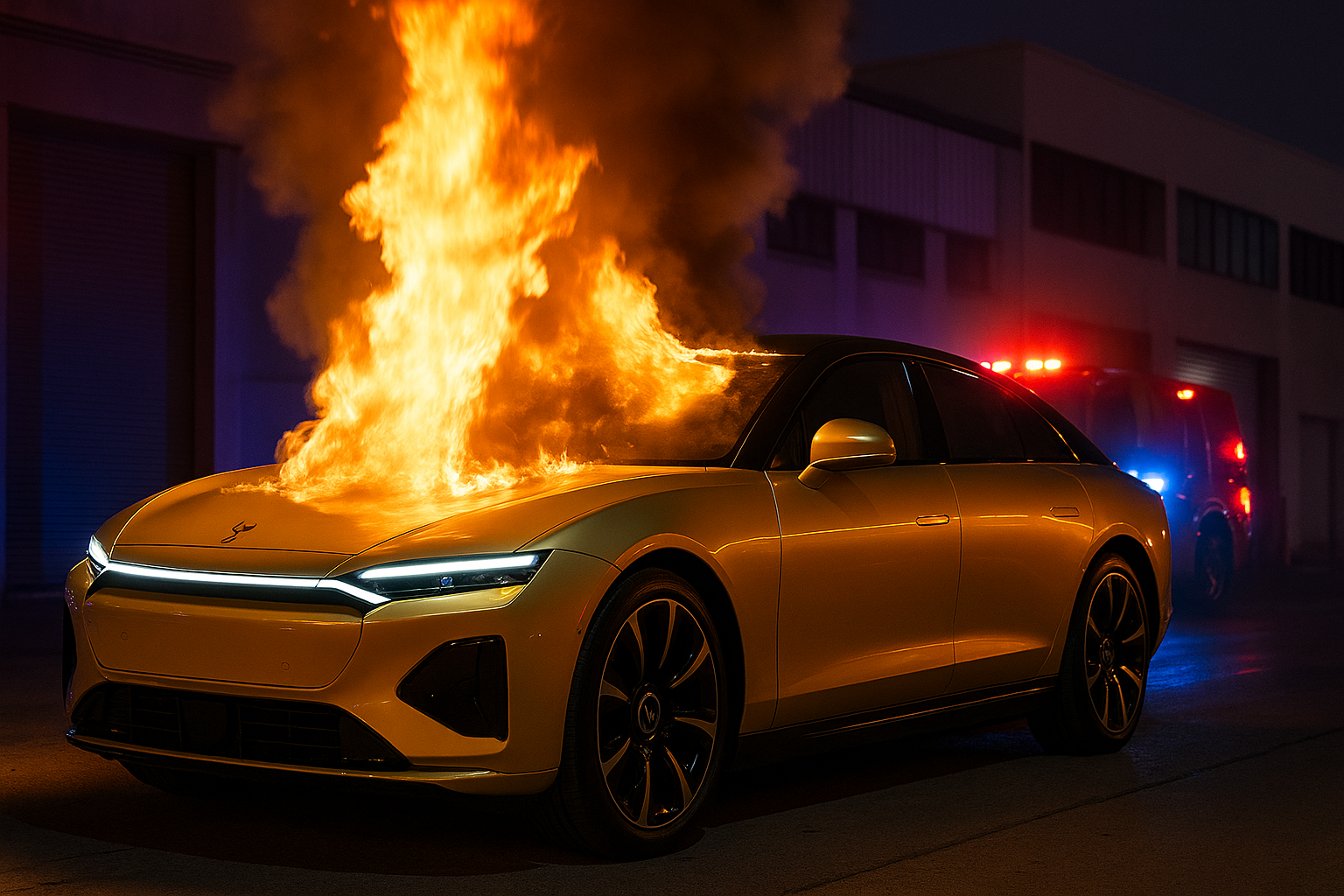
Faraday Future, one of the most talked-about names in the electric vehicle (EV) startup world, has once again found itself in the headlines—but not for a new product launch or a major investment round. Instead, the company reported a serious incident when an early prototype of its FF 91 electric SUV caught fire and exploded at its Los Angeles headquarters.
While no injuries were reported, the blast caused significant damage to a secondary building on the property, leading city officials to declare the structure unsafe until repairs can be completed. For a company already struggling with financial instability, production delays, and leasing issues, this fire adds yet another layer of complexity to Faraday Future’s turbulent journey.
The Incident – What Happened?
The fire broke out early Sunday morning, with emergency services receiving the first report around 4:37 a.m. Fire crews were able to extinguish the flames within 40 minutes. However, during that time, the prototype vehicle exploded, damaging part of the two-story building where it was housed.
Officials from the Los Angeles Department of Building and Safety inspected the site and determined that the structural damage was severe enough to warrant a “red tag” designation, meaning the building could not be reoccupied until reinforced construction work is completed.
Despite the seriousness of the blast, there were no casualties and no other vehicles or employees were harmed.
What Faraday Future Said
In a public statement, the company described the damaged prototype as an “FF 91 show vehicle.” According to Faraday Future:
- The battery pack was not the cause of the fire.
- The blast likely originated from either a short circuit in showroom wiring or a loose connection in the vehicle’s 12-volt low-voltage system.
- Early prototypes did not use the same interior materials as current production vehicles, meaning flammability standards were not up to present-day requirements.
This explanation is important because battery-related fires are a common fear in the EV industry. By ruling out the high-voltage battery pack, Faraday Future is attempting to reassure customers and investors that the incident does not affect its production vehicles.
A Look at the FF 91 and Faraday’s History
Faraday Future first unveiled the FF 91 electric SUV back in 2016, promising a futuristic EV with groundbreaking technology. At the time, it was positioned as a competitor to Tesla, Lucid, and other premium EVs.
Key Highlights of the FF 91:
- Power Output: Up to 1,050 horsepower
- Acceleration: 0–100 km/h in under 3 seconds
- Range: Around 600 km (depending on battery configuration)
- Interior: Massive in-car screens, AI-based user interface, and luxury appointments
However, the journey to bring the FF 91 to market has been rocky. Financial troubles, executive turnover, and lawsuits delayed production for years. It wasn’t until 2023 that limited quantities were finally delivered, mostly to early investors and influencers.
The fire couldn’t have come at a worse time. Faraday Future’s headquarters building is not even owned by the company anymore.
- The automaker sold its property in 2019, during a financial crisis.
- Since then, it has leased the site back to continue operations.
- In early 2024, Faraday Future was sued by its landlord due to late rent payments. The case was eventually settled, but the lease was scheduled to expire by the end of September 2025.
The recent explosion puts the company in a complicated situation: repairing a leased facility, managing its strained financial resources, and maintaining public confidence in its vehicls.
Why the Fire Matters Beyond Faraday Future
This incident shines a spotlight on larger issues within the EV industry:
- Prototype Safety
Early-stage vehicles often lack the rigorous safety standards of production models. The Spectre Bailey fire highlights how prototype testing must be carefully controlled to avoid such catastrophic events. - EV Perception
Battery fires are a hot-button topic in the electric vehicle market. Even though Faraday Future insists the battery wasn’t to blame, any EV fire has the potential to raise public concern about the technology. - Startups Under Pressure
Unlike established automakers, startups like Faraday Future don’t have deep financial reserves. A single setback—whether financial, legal, or technical—can cast doubt on the company’s survival.
Possible Causes of the Fire
Faraday Future’s internal team is investigating the exact cause, but the company has suggested two possible origins:
- Electrical Short in Showroom Wiring: External infrastructure failure may have sparked the fire, independent of the vehicle.
- 12V Low-Voltage System Fault: A loose connection in the prototype’s auxiliary electrical system may have triggered the incident.
Since the vehicle was one of the earliest prototypes, its interior materials were more flammable than production-approved standards, which allowed the fire to spread quickly once started.
What’s Next for Faraday Future?
The company now faces several challenges:
- Repairing or relocating facilities while the damaged building remains off-limits.
- Reassuring customers and investors that its production FF 91 vehicles are safe.
- Stabilizing finances as its lease nears expiration in late 2025.
- Continuing production despite reputational setbacks.
For a startup that has already faced years of financial uncertainty and leadership changes, the road ahead remains difficult.
Pros and Cons of Faraday Future’s Situation
Pros
- No injuries were reported in the incident.
- The company clarified that the main high-voltage battery was not involved.
- The fire only affected an old prototype, not a production vehicle.
Cons
- Significant damage to company property.
- Adds pressure to a financially unstable business.
- Negative headlines may impact consumer trust.
- Lease complications could disrupt operations further.
Conclusion
The Faraday Future prototype fire and explosion is another reminder of the unpredictable road EV startups face. While the company insists its production cars are unaffected, the damage to its Los Angeles facility and the reputational hit add fresh challenges to a company already fighting to stay afloat.
For Faraday Future, survival depends not only on addressing the aftermath of this fire but also on stabilizing its finances, reassuring customers, and proving that its vision for the FF 91 can finally translate into consistent production and sales.
This event underscores a larger reality: in the high-stakes world of electric vehicles, even a single prototype can become a turning point in a company’s story.