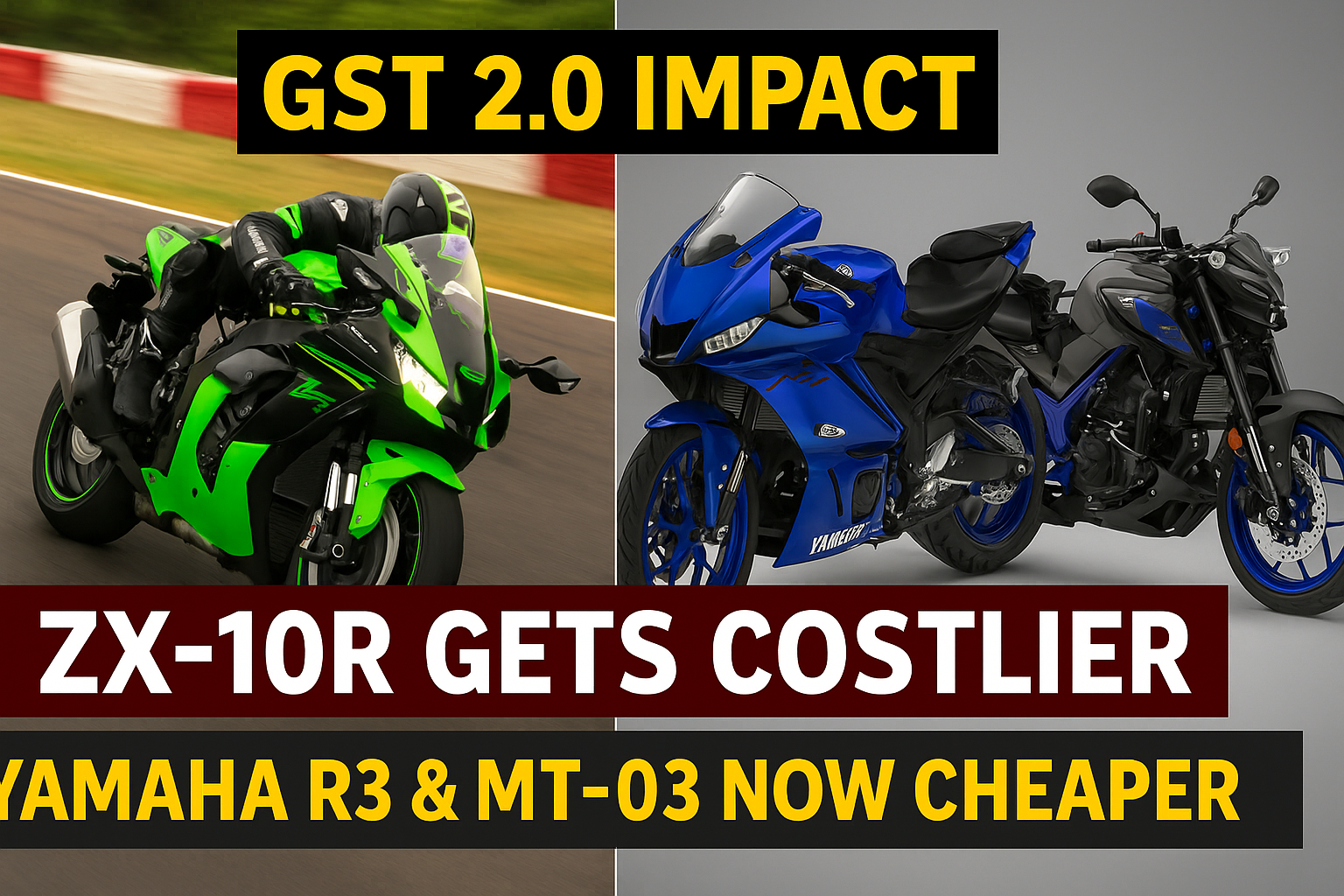
The new GST 2.0 reform has reshaped India’s motorcycle landscape in just a few weeks. While large-capacity superbikes are feeling the pinch with higher taxes, smaller-capacity bikes under 350 cc are enjoying welcome price drops.
Among the biggest headlines:
- The 2026 Kawasaki ZX-10R has crossed the ₹20 lakh mark after the new tax slab for motorcycles above 350 cc kicked in.
- Meanwhile, Yamaha Motor India has cut prices of its twin-cylinder R3 and MT-03, passing on GST benefits directly to customers.
The contrast between the two stories perfectly captures how the government’s revised tax brackets are affecting India’s two-wheeler industry — favoring mid-range commuters while squeezing high-performance machines.
Kawasaki ZX-10R – The Green Monster Crosses ₹20 Lakh
A Victim of GST 2.0’s Higher Bracket
India Kawasaki Motors finds itself among the hardest-hit manufacturers under GST 2.0. The government’s new rule pushes all motorcycles above 350 cc into the 40 percent GST slab, compared to the earlier 28 percent rate.
Since nearly all of Kawasaki’s portfolio sits above this threshold, including the Z900, Ninja 1000SX, and ZX-10R, the effect has been immediate and significant.
Just weeks before the reform, Kawasaki launched the 2026 ZX-10R at ₹ 19.49 lakh — roughly ₹ 99,000 costlier than the 2025 model due to new color options. After September 22, when GST 2.0 took effect, the price jumped another ₹ 1.30 lakh, bringing the total to ₹ 20.79 lakh (ex-showroom).
A Timeline of Price Hikes
| Period | Model Year | Price (Ex-Showroom) | Change |
| August 2025 | ZX-10R (2025) | ₹ 18.50 lakh | — |
| September 2025 | ZX-10R (2026 Launch) | ₹ 19.49 lakh | + ₹ 0.99 lakh |
| October 2025 | ZX-10R Post GST 2.0 | ₹ 20.79 lakh | + ₹ 1.30 lakh |
Within a month, the ZX-10R became ₹ 2.29 lakh more expensive — yet it still manages to retain its most-affordable-1000 cc-superbike crown.
Why the ZX-10R Still Makes Sense
Even with its new price tag, the ZX-10R remains a value-driven superbike thanks to several strategic advantages:
- Locally Assembled CKD Model
Kawasaki brings the ZX-10R as a Completely Knocked Down (CKD) kit, assembled in India. This drastically reduces import duties compared to CBU rivals. - Raw 200 hp Performance
Its 999 cc inline-four engine generates 205 hp and 112 Nm, making it the only superbike in India offering over 200 hp for about ₹ 21 lakh. - Proven WSBK Pedigree
The chassis and aerodynamics draw directly from Kawasaki’s World Superbike Championship program, ensuring world-class performance on track and street alike. - Reliability & Service Network
Kawasaki’s reputation for dependable engines and expanding after-sales support further cements the ZX-10R’s desirability.
Core Specifications
| Parameter | Details |
| Engine | 999 cc, 4-cyl, liquid-cooled |
| Power | 205 hp @ 13,200 rpm |
| Torque | 112 Nm @ 11,400 rpm |
| Transmission | 6-speed, bi-directional quickshifter |
| Front Suspension | Showa Balance Free Fork (fully adjustable) |
| Rear Suspension | BFRC Lite Shock absorber |
| Brakes | Dual 330 mm front discs / 220 mm rear |
| Kerb Weight | 207 kg |
| Electronics | IMU-based traction control, launch control, cornering ABS, power modes |
Competitors & Market Position
| Model | Power | Price (Ex-Showroom) | Import Type |
| Kawasaki ZX-10R | 205 hp | ₹ 20.79 lakh | CKD |
| BMW S 1000 RR | 210 hp | ₹ 23.75 lakh | CBU |
| Honda CBR1000RR-R | 215 hp | ₹ 29.00 lakh | CBU |
| Suzuki GSX-R1000R | 202 hp | ₹ 22.80 lakh | CBU |
| Ducati Panigale V4 | 215 hp | ₹ 27.50 lakh | CBU |
Despite the tax hike, the ZX-10R continues to undercut every rival by ₹ 3–8 lakh, keeping its “superbike for the masses” reputation alive.
Yamaha R3 & MT-03 – The Winners of GST 2.0
While the litre-class crowd faces steeper taxes, the sub-350 cc segment has gained a reprieve.
Yamaha Motor India has now updated prices for its R3 and MT-03, and both models are ₹ 20,000 cheaper than before.
| Model | Old Price | New Price | Difference |
| Yamaha R3 | ₹ 3.59 lakh | ₹ 3.39 lakh | – ₹ 20,000 |
| Yamaha MT-03 | ₹ 3.50 lakh | ₹ 3.30 lakh | – ₹ 20,000 |
These new prices are live on Yamaha’s official site, making both bikes more accessible to riders seeking refined twin-cylinder performance.
Why Yamaha’s Price Cut Matters
At launch, the R3 and MT-03 were criticized for their premium pricing, especially against single-cylinder competitors like the KTM 390 Duke or TVS Apache RTR 310. Yamaha later addressed this by cutting over ₹ 1 lakh from the launch price.
Now, with GST relief, the R3 and MT-03 look even more appealing. For enthusiasts who value refinement, linear power delivery, and Japanese reliability, these machines represent a sweet balance between commuter practicality and weekend fun.
What’s Under the Hood
Both bikes share Yamaha’s 321 cc, parallel-twin DOHC engine, producing around 42 hp and 29.5 Nm. The six-speed gearbox and slipper clutch make them easy to handle in traffic yet responsive at highway speeds.
The R3 continues as a faired sportbike, while the MT-03 adopts a naked streetfighter persona with upright ergonomics and minimalist design.
International Model Updates – Awaiting India Launch
Globally, Yamaha unveiled new-generation R3 and MT-03 models in 2024, featuring updated LED lighting, redesigned frames, and improved electronics. However, there’s no official timeline yet for their Indian debut.
Given the improved pricing, Yamaha India may retain the current versions for some time before introducing the facelifted international variants.
How GST 2.0 Divides the Market
The dual impact of GST 2.0 is clear:
- Bikes below 350 cc → cheaper, attracting new buyers.
- Bikes above 350 cc → costlier, squeezing superbike affordability.
Manufacturers like Yamaha, Honda, and TVS stand to gain in the sub-350 cc category, while Kawasaki, Triumph, and Ducati must reassess pricing and local-assembly strategies.
Expert Analysis – What This Means for Riders
- Mid-range segment growth: The 250–350 cc category will see a demand surge as affordability improves.
- CKD advantage expands: Brands adopting the CKD model (like Kawasaki and Triumph India) will soften the GST impact.
- Superbike niche shrinks: High-performance litre-class bikes may become rarer purchases, shifting focus toward mid-capacity sport machines.
Final Verdict
The Kawasaki ZX-10R, now priced at ₹ 20.79 lakh, still offers unmatched power per rupee and remains India’s most accessible 1000 cc superbike. The tax hike may sting, but Kawasaki’s CKD strategy keeps it well below rival prices.
Meanwhile, Yamaha R3 and MT-03 riders finally have reason to smile — with a GST-driven price cut that improves affordability without any feature compromise.
Together, these shifts underline India’s evolving two-wheeler market: one where performance and practicality are finding balance under new tax realities.