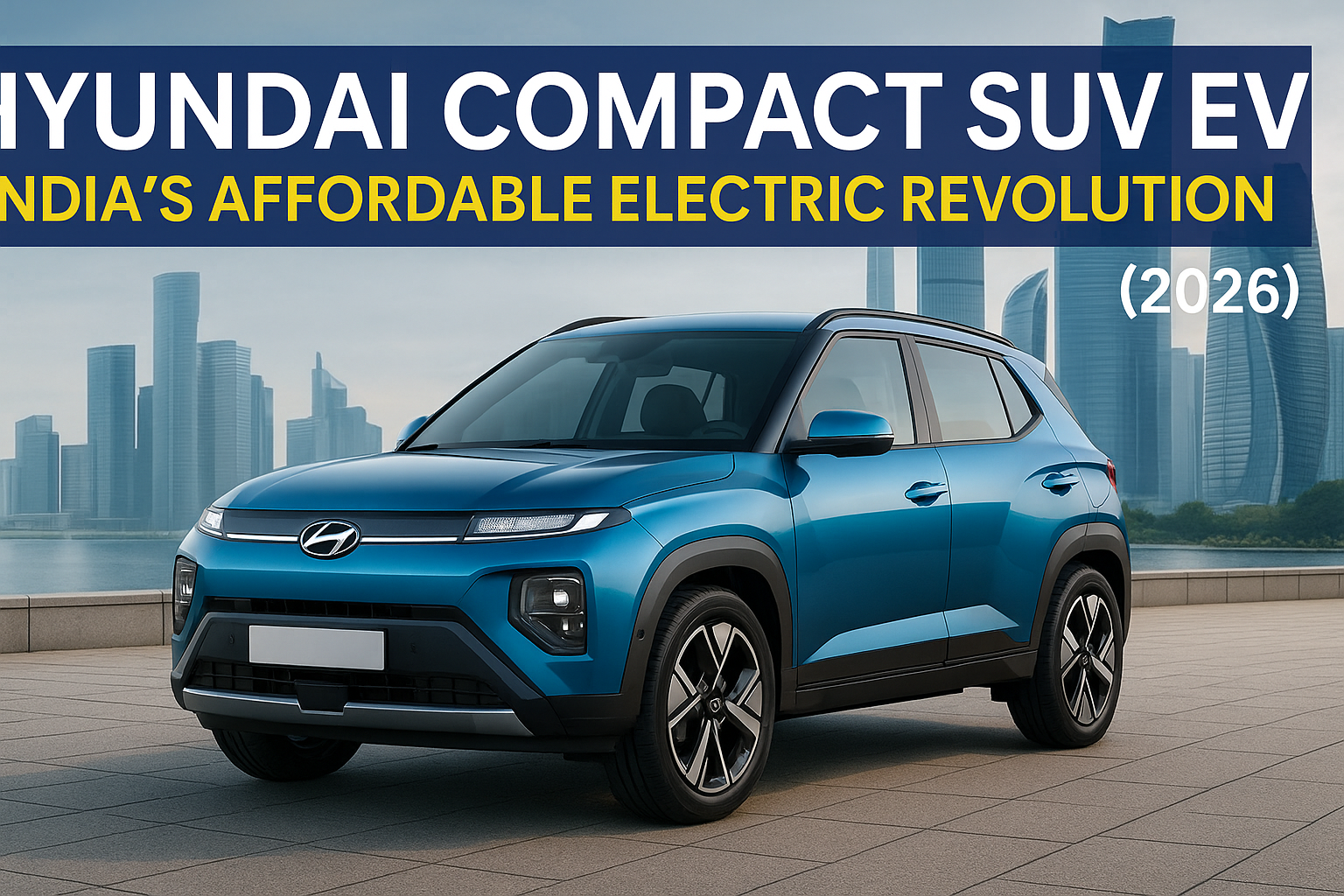
Hyundai has officially confirmed what many EV enthusiasts have been waiting for — a Made-in-India Compact SUV EV. The brand’s upcoming small electric SUV will be positioned below the Creta Electric, bringing Hyundai’s electric mobility strategy into the mainstream Indian market.
This new model represents more than just another EV launch; it’s Hyundai’s step toward localized, affordable electrification — designed, engineered, and manufactured specifically for Indian buyers. With this, Hyundai is aiming to capture the space currently left open between budget EV hatchbacks and premium electric SUVs.
The project aligns with Hyundai’s long-term vision of making India a global EV manufacturing hub, emphasizing high localization, sustainability, and affordability.
Exterior Design: Compact, Practical, and Futuristic
Hyundai has not revealed the official design yet, but the upcoming compact SUV EV is expected to carry the brand’s latest Sensuous Sportiness design language.
Possible Design Direction
According to industry reports, the SUV might be based on the Hyundai Inster EV, which has already been showcased globally. However, Hyundai will likely make major design tweaks for the Indian market, giving it a cleaner, more sophisticated appearance while maintaining a modern compact SUV stance.
You can expect:
- Boxy silhouette for maximized cabin space
- LED DRLs with signature Hyundai light bar
- Closed-off EV grille for aerodynamics
- Chunky bumpers and roof rails for a sportier appeal
- Dual-tone colour options for premium flair
Alternatively, Hyundai could also choose to electrify the Venue, turning it into a Venue EV. Given that the 2025 Venue is due for an update soon, with fresh styling and tech, the platform could be perfect for a compact EV version — especially since both models would share a sub-4m footprint.
Interior & Features: Hyundai’s Comfort DNA Continues
Inside, Hyundai’s compact SUV EV is expected to combine smart technology with everyday practicality — a hallmark of the brand.
Likely Interior Highlights
- Dual-display setup (digital instrument cluster + touchscreen infotainment)
- Wireless Android Auto & Apple CarPlay
- Automatic climate control
- Connected car technology (Bluelink EV integration)
- Ambient lighting
- Premium soft-touch materials
- Wireless charging and multiple USB-C ports
Since Hyundai already equips its current petrol SUVs with class-leading interiors, we can expect this EV to set new standards for comfort, build quality, and convenience in the compact electric segment.
Additionally, Hyundai may include EV-specific features like:
- Regenerative braking with multiple levels
- Drive modes (Eco, Normal, Sport)
- Battery status monitoring
- Charging schedule control through the app
Performance: Small Size, Strong Efficiency
The upcoming Hyundai Compact SUV EV will likely be offered with two battery options — catering to different types of users.
| Variant | Battery Pack | Range (Approx.) | Power Output |
| Standard Range | 35-40 kWh | 300 km | 100 PS |
| Long Range | 45-50 kWh | 350 km+ | 120 PS |
These numbers position it perfectly for urban driving with occasional highway usability.
The EV will use a front-wheel-drive setup, with its electric motor providing instant torque and brisk performance typical of Hyundai’s EV lineup. Expect 0–100 km/h times in under 10 seconds for the Long Range variant, making it quick yet efficient.
Battery & Charging Options
Hyundai’s local focus means that the battery packs could be sourced or assembled in India, significantly cutting costs.
The upcoming EV is expected to support:
- Fast DC charging (up to 80 kW) — 10–80% in under 40 minutes
- Standard AC wall charging (3.3 kW / 7.2 kW) for home use
- Vehicle-to-Load (V2L) capability for powering devices or small appliances
This blend of performance and practicality ensures that the compact SUV EV won’t just be an urban commuter — it will be a flexible companion for every lifestyle.
Platform and Localization
Hyundai is expected to base the new EV either on its K2 ICE platform (modified for EV use) or a new hybridized modular EV platform derived from the global Inster model.
Crucially, Hyundai has confirmed that this EV will be built entirely in India with over 70% localization. This includes battery assembly, software, and drivetrain calibration.
Such deep localization will:
- Reduce costs significantly
- Enable competitive pricing
- Qualify for government EV incentives
- Support Hyundai’s “Make in India for the World” strategy
This move ensures that India will not just be a market — but a production base for future Hyundai EV exports to Southeast Asia and Africa.
Expected Features at a Glance
| Category | Expected Highlights |
| Infotainment | 10.25-inch touchscreen, connected tech |
| Comfort | Climate control, wireless charging |
| Safety | 6 airbags, ESC, hill-start assist |
| Convenience | Digital key, 360° camera, cruise control |
| EV Tech | Fast charging, regen modes, drive modes |
| Range | 300–350 km (expected) |
With this, Hyundai aims to bring a premium yet accessible EV experience to buyers upgrading from petrol hatchbacks and compact SUVs.
Price and Launch Timeline
Hyundai’s India-specific Compact SUV EV is expected to launch between late 2026 and early 2027.
The company’s goal is to hit the sweet spot between affordability and practicality — a space that currently has very few players.
| Variant | Expected Price (Ex-Showroom) |
| Standard Range | ₹9.99 lakh – ₹13 lakh |
| Long Range | ₹14 lakh – ₹18 lakh |
If Hyundai manages to keep the base variant under ₹10 lakh, it will become India’s most affordable globally-branded SUV EV, setting a new benchmark in the subcompact EV category.
Competition Landscape
The compact EV segment is rapidly evolving, but there’s still space for a strong mainstream player. When launched, Hyundai’s small EV will rival:
- Tata Punch EV
- Citroën ëC3
- MG Comet EV (Top Trim)
- Upcoming Maruti Suzuki eVX (Base Variant)
Hyundai’s strengths — global R&D, premium interiors, reliability, and service network — could make it the most balanced choice in this segment.
Sustainability and Local Impact
Beyond sales, the Compact SUV EV aligns with Hyundai’s broader environmental goals. The company plans to make all its Indian facilities carbon-neutral by 2045, with local production focused on recyclable materials, renewable power, and zero-waste assembly lines.
This means Hyundai’s new EV isn’t just a car — it’s part of a larger eco-friendly ecosystem, involving green supply chains and circular manufacturing.