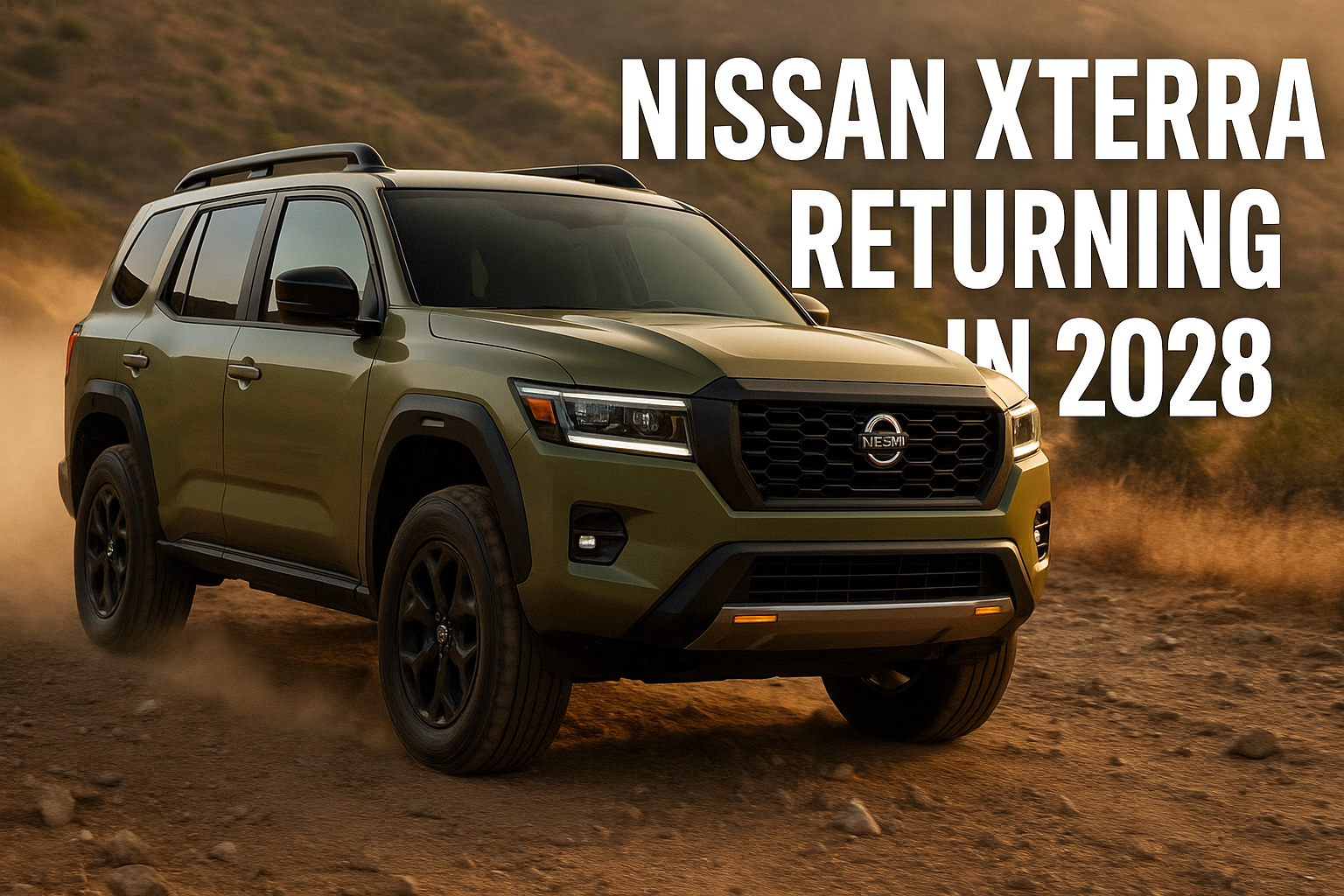
comeback. After years of speculation and dealer reports, Nissan Americas chairman Christian Meunier has confirmed that the Xterra will return in 2028. Built at the company’s Canton, Mississippi facility, the new Xterra will mark Nissan’s re-entry into the mid-size off-road SUV segment—a category that has been heating up with entries like the Toyota 4Runner, Ford Bronco, and Jeep Wrangler.
The confirmation also comes with a twist: Nissan is pausing its earlier plans to build an all-electric SUV in the U.S., signaling a shift in strategy that emphasizes hybrids and traditional off-road models over full EVs.
A Long-Awaited Comeback
The Nissan Xterra was first introduced in 1999 and quickly gained popularity among outdoor enthusiasts thanks to its rugged body-on-frame design, off-road capability, and affordable price point. It was discontinued after the 2015 model year in North America due to declining sales, tightening fuel economy regulations, and safety concerns.
But the SUV’s cult following never disappeared. Online communities, used car demand, and nostalgia have kept the Xterra name alive. With the growing popularity of rugged SUVs in the U.S. market, Nissan’s decision to bring back the Xterra seems perfectly timed.
Official Confirmation and Timeline
Christian Meunier confirmed to Bloomberg that the new Xterra will debut in 2028. This timeline aligns with an earlier dealer meeting where Nissan revealed plans to launch 20 new or refreshed models in the U.S. and Canada by spring 2027, with the Xterra following the next year.
Dealers, according to Meunier, are “super excited” about the revival, describing it as a key example of Nissan regaining momentum in the competitive North American market.
Built in the U.S. – Canton, Mississippi
The revived Xterra will be manufactured at Nissan’s Canton Vehicle Assembly Plant in Mississippi. This is significant for two reasons:
- Job Support and Scale – Nissan plans to use the Xterra’s return to boost production volume at the plant, helping bring costs under control.
- Shift in Strategy – By allocating resources to the Xterra, Nissan has effectively put its earlier U.S.-built EV SUV plans on hold.
While this may disappoint EV advocates, it underscores Nissan’s recognition that hybrids and rugged gas-powered SUVs remain crucial in the short term, especially in markets like the U.S. where off-road vehicles are booming.
Hybrid Powertrain Likely
Although Nissan has not revealed official powertrain details, the company hinted that the Xterra will debut as a hybrid SUV.
- Reports suggest a hybrid V-6 powertrain could be in development.
- The hybrid setup would allow the SUV to balance power and efficiency, meeting modern emissions requirements while retaining rugged capability.
- Nissan has experience with hybrid systems from its global lineup, which could be adapted to the Xterra platform.
This strategy positions the Xterra as a bridge between traditional gas-powered SUVs and future EVs, appealing to both enthusiasts and eco-conscious buyers.
Why Nissan Canceled the U.S. EV SUV Plan
Nissan has been a pioneer in EVs with the Leaf, one of the world’s first mass-market electric cars. However, its U.S. EV sales have struggled compared to competitors like Tesla, Hyundai, and Ford.
Several factors explain why Nissan paused its U.S. EV SUV project:
- Slower-than-expected EV adoption rates in certain states.
- Dealer feedback emphasizing demand for hybrids and off-road vehicles.
- Production costs—building a competitive EV SUV in the U.S. requires massive investment.
- Competition—the EV SUV market is becoming crowded, while the off-road SUV niche is ripe for growth.
By shifting focus, Nissan is playing to its strengths and ensuring it stays competitive in a market that values versatility and ruggedness.
Market Position – Taking on the Giants
The new Xterra will re-enter a highly competitive segment. Direct competitors include:
- Toyota 4Runner – A proven favorite among off-road enthusiasts.
- Ford Bronco – Revived with great success in 2021, appealing to younger adventure-seekers.
- Jeep Wrangler – The segment’s icon, unmatched in heritage and customization.
For Nissan, the key will be offering affordable pricing, practical design, and real off-road ability while leveraging hybrid technology for modern appeal. If executed correctly, the Xterra could capture buyers who want a rugged SUV without the higher price tag of premium rivals.
What to Expect from the 2028 Nissan Xterra
While official specs remain under wraps, here’s what industry experts and early reports suggest:
- Platform: Likely based on Nissan’s Frontier pickup, offering a strong ladder-frame chassis.
- Design: Boxy, rugged styling with nods to the original Xterra’s roofline and utility features.
- Powertrain: Hybrid V-6, possibly paired with an electric motor for added torque.
- Interior: Modern infotainment, off-road drive modes, and advanced driver-assistance systems.
- Pricing: Expected to undercut premium rivals, positioning it as a value-packed off-road SUV.
Dealer and Consumer Excitement
Dealers have expressed optimism, noting that the Xterra revival could reignite excitement around Nissan showrooms. After years of relying heavily on the Rogue and Altima for volume, Nissan needs a product that stirs emotion. The Xterra does just that, appealing to nostalgia while embracing hybrid technology.
Consumers, especially those who owned or admired the original Xterra, are also likely to respond positively. The trend toward outdoor adventure lifestyles, camping, and overlanding makes the timing ideal.
Pros and Cons of Nissan’s Strategy
Pros
- Revives a beloved nameplate with strong brand recognition.
- Strengthens Nissan’s U.S. lineup in the growing off-road SUV segment.
- Hybrid system balances tradition with modern emissions requirements.
- Built in America, supporting jobs and lowering costs.
Cons
- Puts EV expansion on hold in the U.S., potentially hurting Nissan’s long-term EV credibility.
- Faces tough competition from well-established off-road rivals.
- Hybrid-only approach may not fully satisfy hardcore off-road enthusiasts who prefer V-8s or full electrics.
Conclusion
The confirmation of the Nissan Xterra’s return in 2028 marks a bold and strategic move. By reviving a rugged, adventure-ready SUV with hybrid power, Nissan is leaning into consumer demand while carefully balancing regulatory pressures.
At the same time, pausing its U.S. EV SUV plans shows that Nissan is willing to adapt quickly to market realities. While the future of electrification is inevitable, the present still belongs to SUVs that deliver practicality, durability, and excitement.
For off-road fans, this is great news. The Xterra’s comeback promises a blend of nostalgia and innovation, positioning it as a serious contender in one of America’s most competitive segments.