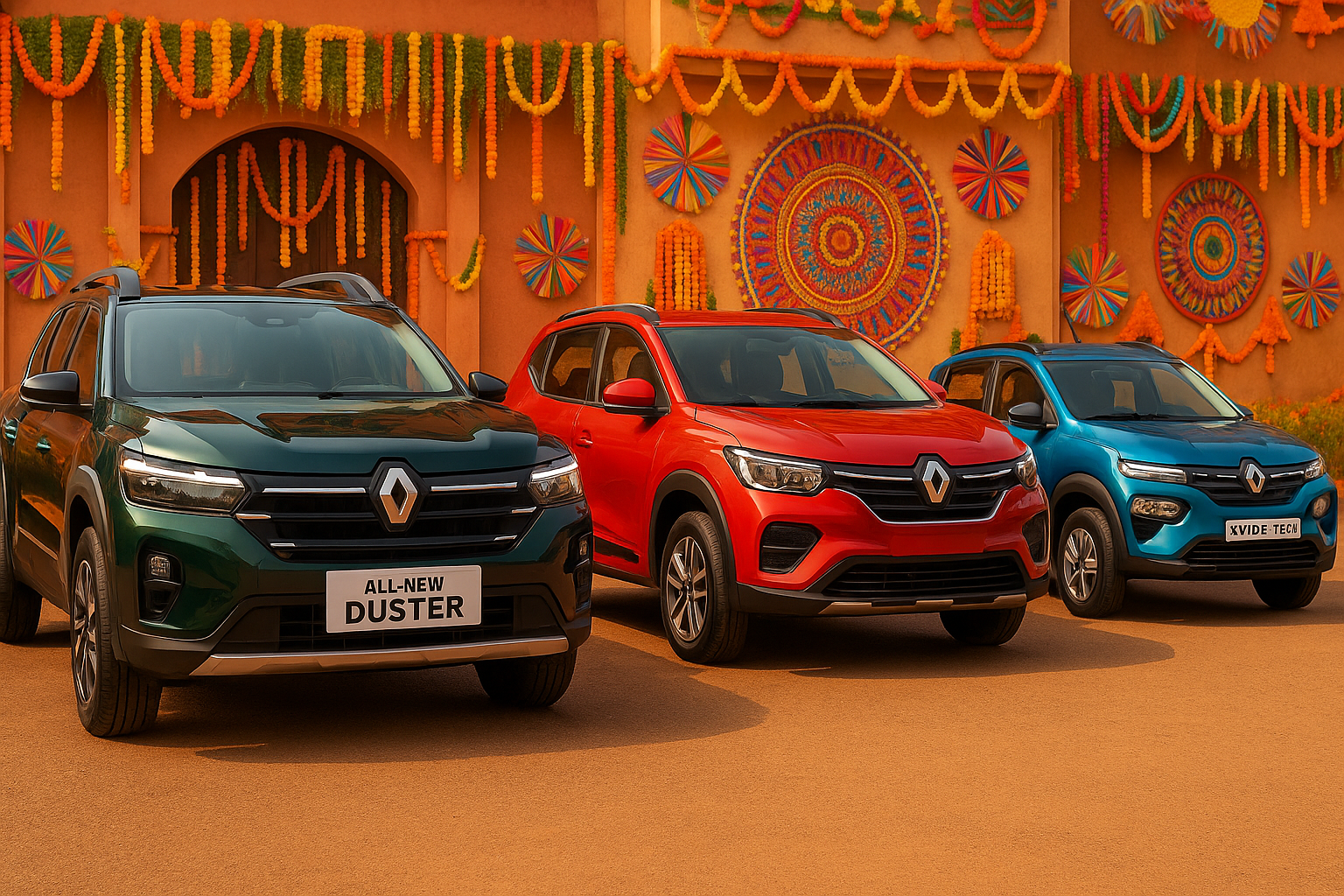
Renault India has been gradually refreshing its lineup to remain competitive in the fast-growing passenger vehicle segment. After recently updating the Kiger and Triber with mid-life facelifts, the French automaker is now preparing a much bigger product offensive.
The brand is set to introduce three new models in India: the all-new Renault Duster, a 7-seater SUV, and the Kwid EV electric hatchback. These launches are expected to strengthen Renault’s presence in both the SUV and affordable EV categories, giving buyers more choices in the coming years.
Let’s take a closer look at the upcoming Renault cars for India.
1. All-New Renault Duster – The Icon Returns
The Renault Duster has been one of the most iconic SUVs in India. Launched in 2012, it created a new segment of compact urban SUVs with rugged looks and practical design. Now, Renault is gearing up to bring the new-generation Duster to India by early 2026.
Design & Platform
- The new Duster will feature a butch, muscular stance, drawing inspiration from the international version.
- Built on the CMF-B platform, the SUV promises improved safety, space, and performance.
- Expect styling revisions specific to the Indian market, including tweaks to bumpers and interior layout.
Engine Options
- Initially, the Duster will be a petrol-only model.
- Power will come from a 1.3-litre turbo petrol engine, producing 154 bhp and 250 Nm of torque.
- A hybrid powertrain is expected to be introduced at a later stage, in line with global emission and fuel efficiency trends.
Features & Equipment
- Updated cabin with a modern touchscreen infotainment system.
- Connected car technology, wireless smartphone integration, and premium upholstery.
- Enhanced safety features with multiple airbags, ABS, ESC, and possibly ADAS in top trims.
The Duster’s return is highly anticipated as it will compete with SUVs like the Hyundai Creta, Kia Seltos, and Maruti Grand Vitara.
2. New 7-Seater SUV – Likely To Be Named Boreal
Alongside the Duster, Renault is also developing a 7-seater SUV designed for larger families. Expected to launch in the second half of 2026, this SUV will be positioned above the Duster in the brand’s portfolio.
Platform & Dimensions
- Built on the same CMF-B platform as the Duster.
- Extended wheelbase for a spacious three-row seating layout.
- Distinctive exterior design with a more premium road presence.
Powertrain Options
- 1.3-litre turbo petrol engine (154 bhp).
- 1.6-litre strong hybrid option producing around 155 bhp, under consideration for India.
- Automatic and manual transmission options expected.
Features & Equipment
- Larger infotainment screen with advanced connectivity.
- Multi-zone climate control and ventilated seats for enhanced comfort.
- ADAS features in higher trims, aligning with global safety norms.
This SUV, potentially codenamed Boreal, will directly take on the Hyundai Alcazar, Mahindra XUV700, Tata Safari, and MG Hector Plus.
3. Kwid EV – Renault’s Affordable Electric Hatchback
While SUVs remain the backbone of the Indian car market, electric mobility is steadily growing. Renault aims to capture the entry-level EV segment with the upcoming Kwid EV.
Design & Styling
- Recently spied test mules suggest the design will remain similar to the ICE Kwid, with subtle EV-specific touches.
- Expect a closed-off front grille, new alloy wheels, and unique EV badging.
- Compact proportions make it ideal for urban commutes.
Battery & Range
- Likely based on the Dacia Spring EV platform.
- Expected 26.8 kWh battery pack.
- Claimed range: 225 km on a single charge (ideal for city use).
- Charging options to include AC wall charger and fast-charging capability.
Positioning & Competition
- The Kwid EV will be among the most affordable electric cars in India.
- Competes with Tata Tiago EV, Citroen eC3, and MG Comet EV.
- Aimed at first-time EV buyers seeking a budget-friendly option.
Why Renault’s Upcoming Lineup Matters
Renault’s three upcoming models underline its two-pronged strategy:
- Strengthen its SUV portfolio – with the new Duster and a 7-seater sibling, Renault will directly challenge leading mid-size and premium SUV players.
- Enter the affordable EV market – with the Kwid EV, Renault can attract budget-conscious urban buyers exploring electric mobility.
This strategy allows Renault to cover both traditional ICE demand and emerging EV adoption in India.
Market Impact & Expectations
- Duster comeback: Expected to revive Renault’s image as an SUV innovator in India.
- 7-seater SUV: Will expand the brand into the premium family car segment.
- Kwid EV: Could emerge as one of the most affordable EVs, making electric mobility more accessible.
With competition intensifying in both the SUV and EV segments, Renault’s upcoming launches will be crucial in shaping its future in India.
FAQs
Q1: When will the new Renault Duster launch in India?
The new-generation Duster is expected to launch in early 2026.
Q2: What engines will power the new Duster?
It will be offered with a 1.3-litre turbo petrol engine initially, with a hybrid powertrain planned for later.
Q3: What is Renault’s upcoming 7-seater SUV?
A new three-row SUV, possibly named Boreal, will launch in late 2026, based on the CMF-B platform.
Q4: When is the Renault Kwid EV launching in India?
An official date is not confirmed, but spy shots suggest its India debut is near, likely within the next year.
Q5: What will be the range of the Kwid EV?
The Kwid EV is expected to feature a 26.8 kWh battery pack with a claimed 225 km range per charge.
Conclusion
Renault is gearing up for one of its most significant product pushes in India with two new SUVs and one electric hatchback. The new-gen Duster will reignite nostalgia while offering modern technology, the 7-seater SUV will cater to larger families, and the Kwid EV will make electric mobility more affordable than ever.
With this aggressive lineup, Renault is set to strengthen its foothold in India’s competitive automobile market, targeting both traditional SUV buyers and emerging EV adopters.
As these launches unfold between 2025 and 2026, Renault could be looking at a major revival in India, combining its legacy of practical, value-driven cars with the future of sustainable mobility.