As the global automotive industry accelerates toward sustainability, Suzuki has stepped into the spotlight once again with the Fronx Flex-Fuel Concept. Set to make its public debut at the Japan Mobility Show 2025, this innovative version of the popular compact crossover demonstrates Suzuki’s expanding commitment to carbon-neutral mobility through alternative fuel technologies.
Although the Fronx Flex-Fuel concept doesn’t deviate much from its existing design, its underlying message is powerful — Suzuki’s roadmap to a cleaner, greener future is taking tangible shape. From flex-fuel and compressed biomethane gas (CBG) to battery-electric vehicles (BEVs), Suzuki is diversifying its sustainability portfolio like never before.
Design Overview – Familiar Yet Future-Focused
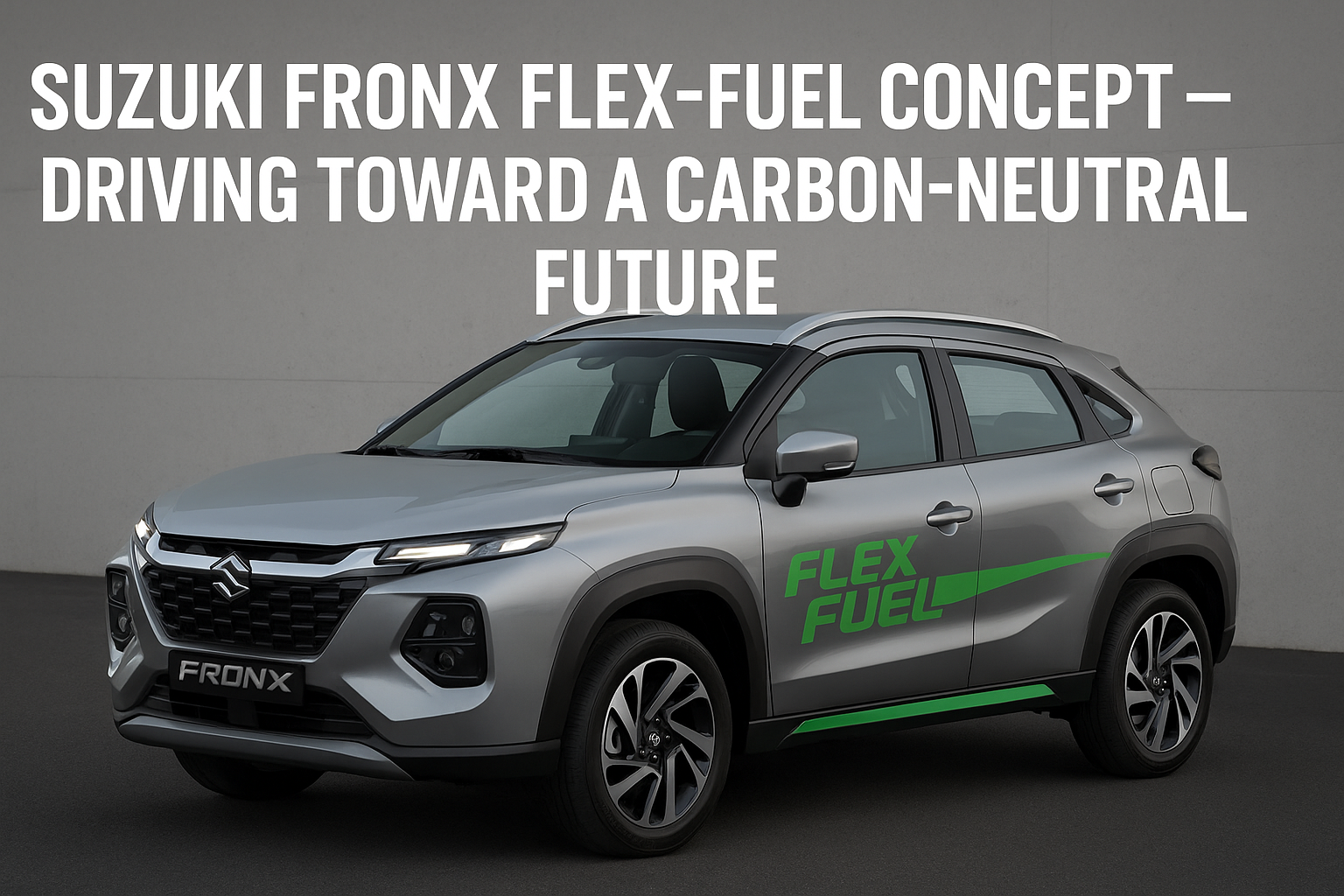
On the design front, Suzuki has opted for subtlety rather than overhaul. The Fronx Flex-Fuel Concept retains the familiar lines, proportions, and styling cues of the standard Fronx. Its coupe-like stance, muscular wheel arches, and raised crossover profile remain untouched.
However, the difference lies in detail and identity. The concept features distinct ‘Flex-Fuel’ decals on the body, serving as a visual cue to distinguish it from its petrol-powered sibling. Suzuki may eventually replace these with a dedicated flex-fuel badge on the tailgate when the production version rolls out — similar to how the brand marks its hybrid and mild-hybrid models.
While the company hasn’t revealed changes to interior materials or dashboard layout, the focus is likely to remain on technology and compatibility enhancements under the hood rather than visual transformation.
What Is Flex-Fuel Technology?
Flex-fuel, short for Flexible Fuel, refers to vehicles that can run on more than one type of fuel — usually a mix of ethanol and petrol. Ethanol, produced from renewable sources like sugarcane or corn, burns cleaner and helps reduce dependency on fossil fuels.
The Fronx Flex-Fuel Concept likely supports E85 (a blend of 85% ethanol and 15% petrol), allowing drivers to switch seamlessly depending on fuel availability.
For countries like India and Brazil, where ethanol production is abundant, this technology can significantly cut carbon emissions and lower running costs. Suzuki’s move aligns with both India’s biofuel policy and Japan’s global carbon neutrality goals.
Suzuki’s Broader Sustainability Vision
The Fronx Flex-Fuel Concept is more than just a single experiment — it’s a crucial part of Suzuki’s long-term sustainability framework. The automaker has confirmed heavy investments in Compressed Biomethane Gas (CBG) and Battery Electric Vehicles (BEVs) as complementary pillars to its green mobility goals.
1. Compressed Biomethane Gas (CBG) – Green Fuel from Waste
Suzuki plans to leverage CBG technology as a renewable and cleaner alternative to CNG. CBG is produced from organic waste such as agricultural residue or animal manure, offering not just lower emissions but also energy circularity — turning waste into fuel.
This aligns perfectly with India’s GOBAR-Dhan (Galvanizing Organic Bio-Agro Resources Dhan) initiative, under which the Indian government promotes CBG plants across rural areas. By supporting CBG-powered vehicles like the Maruti Suzuki Victoris, Suzuki is tapping into an eco-friendly yet practical market solution.
2. BEVs and Electrification Roadmap
Alongside flex-fuel and CBG, Suzuki is steadily working toward battery electric mobility. The company is developing multiple BEV models for global and domestic markets under its “Carbon Neutral by 2050” target.
At the Japan Mobility Show, Suzuki will showcase several electric prototypes, including:
- e-Vitara BEV – an all-electric compact SUV
- Vision e-Sky BEV Concept – a futuristic electric design study
- e-Every – an electric version of the Every commercial van
These vehicles collectively represent Suzuki’s multi-path strategy — investing in all feasible sustainable technologies rather than focusing solely on one.
The Japan Mobility Show 2025 – A Global Stage
Formerly known as the Tokyo Motor Show, the Japan Mobility Show has evolved into one of the world’s most prestigious automotive exhibitions. It’s not just about cars anymore — it’s about showcasing mobility innovations that shape the future of transport.
Held from October 30 to November 9, 2025, at Tokyo Big Sight in Odaiba, the event will bring together automakers, tech companies, and innovators to highlight cutting-edge mobility trends.
Suzuki’s display this year is one of the most diverse line-ups among Japanese manufacturers. Apart from the Fronx Flex-Fuel Concept, visitors will see:
- Facelifted Suzuki X-Bee
- Suzuki Jimny Nomade (India-made 5-seater version)
- Spacia mini-MPV
- Vision e-Sky BEV Concept
- e-Every Commercial Van Concept
- e-Vitara BEV Prototype
- Maruti Suzuki Victoris in both CBG and CNG variants
This mix of flex-fuel, CBG, and electric vehicles underscores Suzuki’s flexible technology roadmap, designed to serve different markets and environmental regulations.
India’s Growing Role in Suzuki’s Global Vision
Interestingly, the Fronx, Jimny Nomade, and Victoris all have direct links to India, highlighting Maruti Suzuki India Limited (MSIL) as a key contributor to Suzuki’s R&D and production ecosystem.
The Jimny Nomade, for example, is the 5-seater version manufactured exclusively in India and exported worldwide. Similarly, the Fronx — originally launched under Nexa dealerships in India — has become a global model thanks to its success in emerging markets.
India’s push toward ethanol blending, CBG infrastructure, and EV localization perfectly aligns with Suzuki’s sustainability ambitions. The Fronx Flex-Fuel Concept could very well preview a version tailored for the Indian biofuel market, supporting the country’s E20 and upcoming E85 adoption targets.
Potential Powertrain and Technical Updates
While Suzuki hasn’t shared detailed mechanical specifications for the Fronx Flex-Fuel Concept, it is expected to use the 1.2-litre K-Series DualJet engine, optimized to run on high-ethanol blends.
Key highlights may include:
- Modified fuel injectors and ECU calibration for ethanol compatibility
- Corrosion-resistant materials in the fuel lines and tank
- Emission compliance with stricter Euro and Bharat Stage norms
- Improved efficiency at partial load conditions
Flex-fuel vehicles typically deliver slightly lower mileage compared to pure petrol models but offset this with lower carbon emissions and operating costs.
Suzuki’s Global Carbon-Neutral Commitment
Suzuki has publicly committed to achieving carbon neutrality across its entire product line-up by 2050. The strategy includes:
- Expanding flex-fuel and hybrid models in developing countries
- Launching fully electric vehicles in advanced markets
- Integrating CBG-based mobility solutions in regions like India
- Continuing research into lightweight materials and fuel efficiency
By blending electrification with renewable fuels, Suzuki aims to serve both mature and emerging markets with localized, affordable, and sustainable mobility solutions.
The Fronx Flex-Fuel Concept – A Symbol of Transition
The Suzuki Fronx Flex-Fuel Concept is not just another variant — it’s a symbol of the transition phase between internal combustion and full electrification.
Its philosophy is rooted in adaptability:
- Adaptable fuel types (ethanol and petrol)
- Adaptable technology (hybrid and electric integration)
- Adaptable markets (Japan, India, Latin America)
This flexibility is what sets Suzuki apart from competitors who are betting entirely on one technology. By adopting a multi-fuel approach, Suzuki ensures its relevance and resilience in diverse markets and regulatory environments.
Final Verdict
The unveiling of the Fronx Flex-Fuel Concept marks a defining moment for Suzuki’s sustainable future. While it may look familiar on the outside, it represents a bold shift in engineering philosophy — one that prioritizes practical innovation over flashy transformation.
From CBG investment to BEV prototypes and ethanol-compatible vehicles, Suzuki’s approach balances environmental responsibility with mass-market accessibility.
As global fuel economies evolve, the Fronx Flex-Fuel may just become a key stepping stone in Suzuki’s carbon-neutral journey, bridging today’s automotive reality with tomorrow’s green vision.