Meta title: Tata Punch CNG vs Hyundai Exter CNG – Real-World Efficiency, Performance, Features (2025)
Meta description: A practical, 1,000+ word comparison of Tata Punch iCNG and Hyundai Exter Hy-CNG Duo. See mileage results (city & highway), performance, features, safety, boot usability, and which CNG mini-SUV suits you in 2025.
Why this duel matters
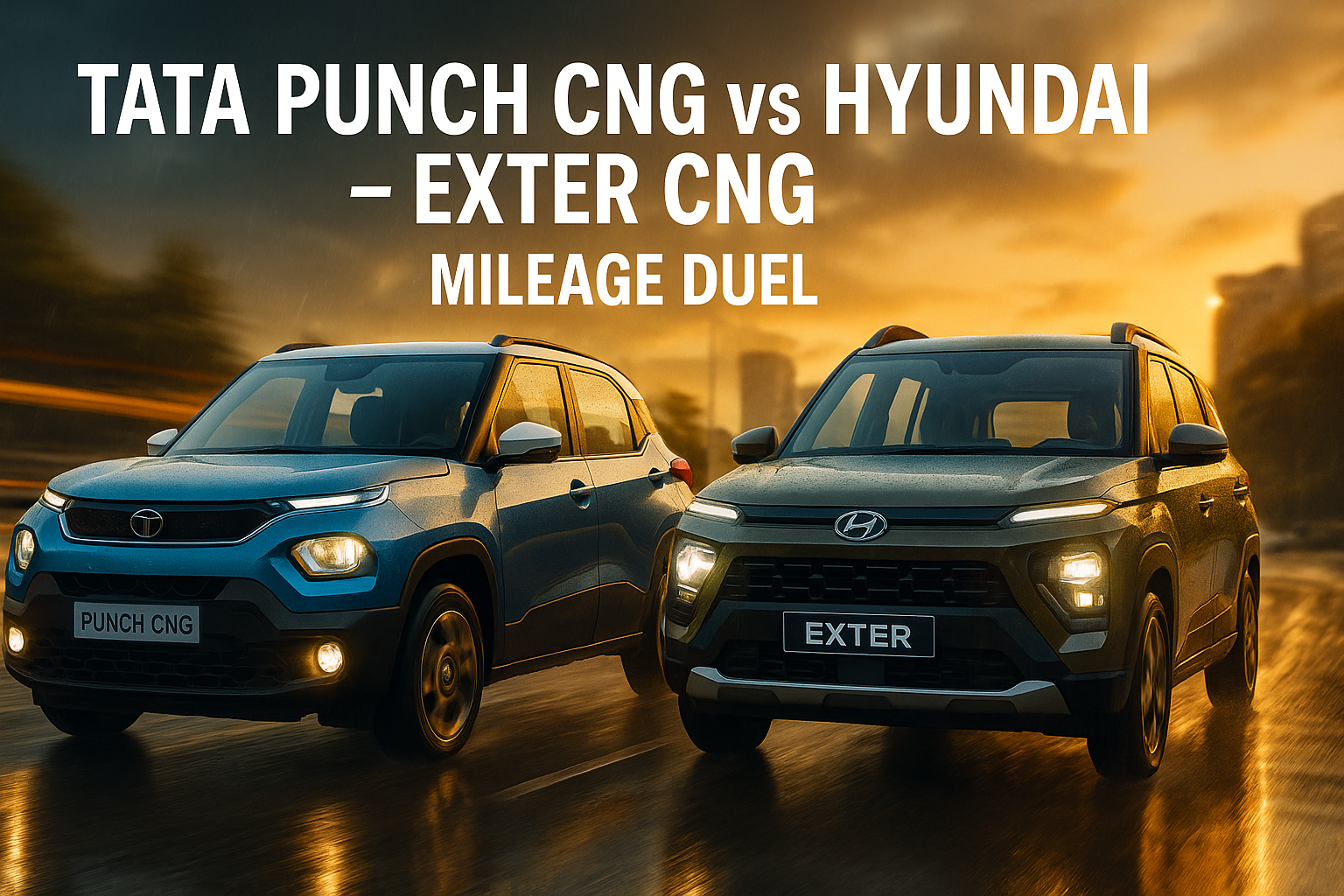
Two years back, the petrol-automatic versions of these mini-SUVs locked horns and the Hyundai edged it on smoothness. The script flips with CNG: both now use dual-cylinder tanks, both claim ~27 km/kg, and both are loaded with the kind of features buyers expect at this price. But the question most shoppers ask isn’t “Which is the fastest?”—it’s “Which one is easier to live with, and which returns better real-world economy without feeling slow or flimsy?”
Below, we keep it simple, ad-safe, and useful: how they feel to sit in, how they drive in traffic, what they drink on the highway, what you actually get on the features list, and—ultimately—who should buy what.
At a glance: dimensions & powertrains
| Tata Punch iCNG | Hyundai Exter Hy-CNG Duo | |
| L/W/H | 3827/1742/1615 mm | 3815/1710/1631 mm |
| Wheelbase | 2445 mm | 2450 mm |
| Engine | 3-cyl, 1199 cc petrol+CNG | 4-cyl, 1197 cc petrol+CNG |
| Power | 73.5 hp @ 6000 rpm | 69 hp @ 6000 rpm |
| Torque | 103 Nm @ 3250 rpm | 95.2 Nm @ 4000 rpm |
| Kerb weight | 1181 kg | 1093 kg |
| Boot (with dual tanks) | ~210 L (usable) | NA (similar compromise) |
| Claimed efficiency | ~27 km/kg | ~27 km/kg |
Read the spec sheet carefully: the Punch has a little more power and torque on paper, but the Exter’s 4-cyl refinement and shorter gearing make it feel stronger at low speeds. Also note the Exter’s lower kerb weight.
Cabin & ergonomics: how they make you feel
Tata Punch iCNG
It’s easy to understand this car’s popularity. High-riding stance, wide-opening doors, and easy ingress make life simple for elderly passengers. The seating height and visible bonnet corners build confidence in tight traffic and during parking. Steering effort is light, the clutch is easy, and the shifter is friendly (if not razor-precise). Individual front armrests are a long-drive blessing, and the audio system punches above its class. The cabin design feels cheerful, and the dual-cylinder CNG layout keeps a usable, squared-off boot floor compared with single-cylinder conversions of the past.
Hyundai Exter Hy-CNG Duo
Hyundai doubles down on user-friendliness. Controls are lighter still, and the overall polish—switch action, stalk weighting, pedal feel—feels a notch up. The lower window line and tidy mirrors give great outward visibility. Fit and finish are marginally better than the Tata’s, but the dark monotone theme doesn’t feel as airy, and the front seats are narrower with less under-thigh support. That said, the cabin remains cleverly packaged, with plenty of storage and a layout that’s easy to learn on day one.
Verdict (cabin): Prefer a commanding view and cushy front seats? The Punch. Want light controls and slightly richer fit-finish? The Exter.
Performance & drivability: traffic first, highways second
The Punch has never been about outright pace, and in CNG tune it feels more laid-back. It keeps up with traffic but asks for patience when you need a quick overtake. Its strength shows at speed: the chassis feels stable and planted on the highway, shrugging off undulations better than you’d expect in this segment.
The Exter counters with refinement. The 4-cylinder engine is quieter, smoother, and more eager to rev. Shorter gearing and smart calibration let it pull from ~1,000 rpm without hesitation, so you’re shifting less in the city. In measured runs, the Exter CNG was convincingly quicker: 0–100 km/h in ~14.85 s versus the Punch’s ~17.85 s, and it’s notably stronger in 20–80 km/h (3rd) and 40–100 km/h (4th)—the bands that matter for quick, safe overtakes.
Highway composure: the Punch feels more settled; the Exter shows more vertical movement on long undulations and sits about 300 rpm higher at an indicated 100 km/h in top gear—one reason it sips slightly more on the open road.
Real-world efficiency: city vs highway
Method (kept simple and fair): run both cars dry on CNG, refill ~2 kg each, drive them in real traffic until empty, repeat on the highway. Because it’s impossible to dispense exactly the same gas quantity every time, efficiency is calculated as distance covered / gas actually filled.
Results you can use:
- City – Punch: ~20.7 km/kg; Exter: ~22.8 km/kg
- Highway – Punch: ~31.0 km/kg; Exter: ~30.3 km/kg
- Combined – both sit close to the ~27 km/kg claim, with the Exter doing better in town thanks to drivability, and the Punch edging it on the highway thanks to calmer cruising.
Takeaway: If your routine is stop-go urban traffic, the Exter CNG will likely save you more over a year. If you rack up inter-city miles, the Punch CNG balances stability and economy well at cruising speeds.
Ride, handling & NVH
- Tata Punch iCNG: Feels tough and secure. Steering is light but consistent, and high-speed stability inspires confidence. Over sharp joints the suspension stays composed and quiet. The extra mass of CNG hardware is well integrated.
- Hyundai Exter CNG: City ride quality is comfortable and quiet. On the highway, the vertical motions over long waves are more noticeable than in the Tata; nothing alarming, but you feel it. NVH is excellent in town—the 4-cyl note is a class advantage.
Driver confidence: those who like a planted feel will prefer the Punch; those who want effortless lightness will lean Exter.
Features & safety: what you actually get on top trims
To level the playing field, consider the equipment you’d find if you bought each car at or near the top of its CNG range.
Punch iCNG (higher trims standout):
- 10.25-inch touchscreen with wireless Android Auto/Apple CarPlay
- Cruise control, rear AC vents, auto climate, rearview camera
- ESP, dual airbags (variant dependent), decent audio
- Wide variant spread: more affordable entry CNG trims than Hyundai
Exter Hy-CNG Duo (higher trims standout):
- Six airbags, tyre-pressure monitoring, hill-start assist
- Electrically folding mirrors, connected features, sunroof
- 8-inch touchscreen with wireless smartphone integration
- In many cities, undercuts the higher Punch CNG trims on price while packing more safety kit
Where each wins:
- Punch: infotainment size, cruise control, sense of robustness, broader CNG variant ladder.
- Exter: safety suite (six airbags, TPMS, HSA), and an overall value-to-features equation that’s hard to ignore.
Practicality: boots, spares, and day-to-day ease
Both use dual CNG cylinders under the boot floor. You do lose luggage height compared with petrol-only versions, but the space is regular enough for soft bags and strollers if you remove the parcel shelf.
- Punch: the boot feels more usable in shape; importantly, Tata provides a full-size spare.
- Exter: ships with a tyre repair kit instead of a full spare on many trims—fine for urban users, less reassuring for frequent highway runs.
Small details that matter daily: the Punch’s front armrests and high H-point reduce fatigue; the Exter’s lighter controls make bumper-to-bumper commutes easier.
Ownership angle: variants & value
- If you want the lowest entry price into a factory CNG mini-SUV, Tata’s wider iCNG variant spread helps.
- If you want maximum safety for the money and a smoother city drive, Hyundai’s feature-weighted CNG trims are compelling—even before you factor in the better urban economy.
As always, check local on-road pricing, insurance and any dealer-level packages; CNG running costs depend on pump prices in your city and how easily you can access refills during pea
Verdict: who should buy what?
Buy the Tata Punch iCNG if you:
- Spend serious time on highways and value straight-line stability.
- Prefer a commanding driving position, cushier front seats and a more usable boot shape.
- Want cruise control and a larger touchscreen on higher trims, plus the reassurance of a full-size spare.
Buy the Hyundai Exter Hy-CNG Duo if you:
- Drive mostly in dense city traffic and want smoother low-rpm response with less shifting.
- Prioritise refinement and safety (six airbags, TPMS, hill-start assist).
- Want a feature-rich, value-leaning top trim that often undercuts the Punch’s higher CNG variants.
One-line takeaway:
The Punch iCNG is the better highway companion; the Exter CNG is the more complete city car and, as a package, the better-rounded buy for most urban families.